Overview of Kyushu
Area
The area of the Kyushu region is about 42,000 square kilometers. This accounts for about one-tenth of Japan’s total land area. Although not as large as Honshu or Hokkaido, it is a region rich in diverse nature and culture.
Population
The population is about 13 million, roughly one-tenth of Japan’s population, about the same as Tokyo. Large cities such as Fukuoka and Kitakyushu in the north attract people, while the south and remote islands have smaller populations and face more advanced aging.
Location
Kyushu is located in the southwestern part of the Japanese archipelago. To the north, it faces Honshu across the Kanmon Strait. To the west, across the East China Sea, it is close to China and Korea. To the south, chains of islands connect to Okinawa and Taiwan. Because of this location, Kyushu has long played an important role as Japan’s “gateway” to the Asian continent.
Nature
Regional Classifications
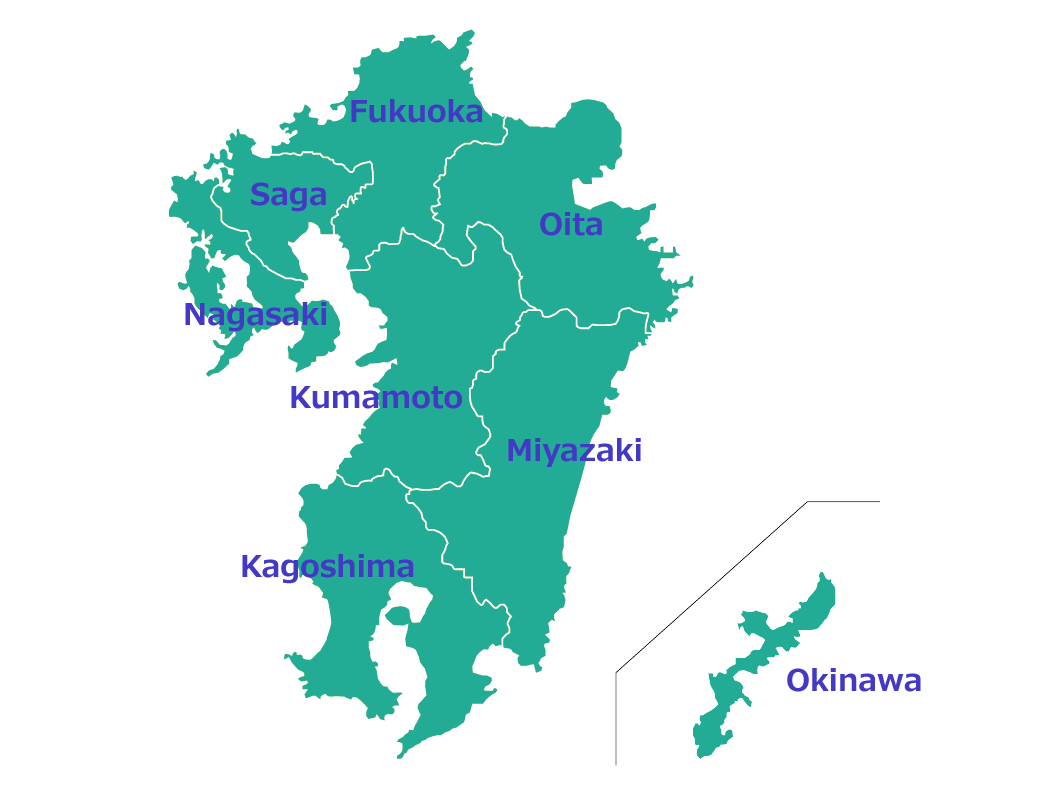
The Kyushu mainland and the Nansei Islands are broadly divided into four areas: north, central, south, and the southwestern islands.
Northern Area: Chikushi Mountains
The Chikushi Mountains spread across the north, centered on Fukuoka, Saga, and Nagasaki prefectures, where mountains and basins intermingle. The Fukuoka and Saga plains are fertile rice-producing areas, while Nagasaki is characterized by rias coastlines and indented ports. Islands close to Korea, such as Iki and Tsushima, are also included.
Central Area: Plains and Volcanic Zones
The central area has wide plains and famous volcanoes.
- Chikugo Plain: A large rice-producing area in southern Fukuoka.
- Kumamoto Plain: Surrounding Kumamoto City, with abundant groundwater suited for farming.
- Yatsushiro Plain: Located in southern Kumamoto, known for vegetables and fruit cultivation.
- Mount Unzen: A volcano in Nagasaki Prefecture, famous along with Unzen hot springs as a tourist destination.
- Mount Aso: One of the world’s largest caldera volcanoes. The Aso grasslands surrounded by its outer rim mountains create a grand landscape.
Southern Area: Mountains and Volcanic Landforms
The southern part of Kyushu is notable for mountains and volcanoes.
- Kyushu Mountains: Spanning Kumamoto, Miyazaki, and Kagoshima, featuring deep valleys and forests.
- Miyazaki Plain: Facing the Pacific Ocean, with long sunshine hours ideal for vegetables and fruit.
- Yatsushiro Plain: Extending from southern Kumamoto to Kagoshima.
- Kirishima Mountains: A volcanic range mentioned in mythology, including Mount Takachiho.
- Sakurajima: An active volcano symbolizing Kagoshima City, constantly emitting smoke.
- Mount Kaimon: A beautiful cone-shaped peak at the tip of the Satsuma Peninsula, nicknamed “Satsuma Fuji.”
- Shirasu Plateau: Formed from volcanic ash deposits. While well-drained, the soil is vulnerable to floods and landslides.
Southwestern Islands: Satsunan and Ryukyu Islands
South of Kyushu lie chains of islands divided into the Satsunan Islands (Tokara and Amami Islands, Kagoshima Prefecture) and the Ryukyu Islands further south (Okinawa, Yaeyama, etc.). These belong to the subtropical zone, with coral seas and mangrove forests distinct from mainland Japan.
Climate
Influence of Warm Currents
Kyushu’s climate is strongly influenced by ocean currents.
- Tsushima Current: A warm current flowing northward through the Sea of Japan, keeping northern Kyushu mild in winter.
- Kuroshio (Japan Current): A strong warm current flowing northward in the Pacific, bringing warm and humid air to the south and the southwestern islands.
Climate of Northern, Central, and Southern Kyushu
Kyushu’s mainland overall belongs to the “Pacific side climate.” Summers are hot and humid, while winters are mild with little snow.
- North: Winters are often cloudy but snow is light.
- Central: High-altitude areas like Aso are cooler and see snowfall.
- South: Long sunshine hours create a warm climate ideal for agriculture.
Climate of the Southwestern Islands
The Nansei Islands have a subtropical climate, with winter average temperatures not falling below 15°C. While rainfall is heavy during the rainy and typhoon seasons, this nourishes rich ecosystems.
Industries
Agriculture
Kyushu is one of Japan’s leading agricultural regions, with distinct characteristics by area.
- North: Rice production in the Chikugo and Saga plains; horticulture such as strawberries and greenhouse vegetables in Fukuoka and Saga.
- South: Livestock farming in Miyazaki and Kagoshima (Miyazaki beef, Kagoshima black cattle); field crops such as sweet potatoes and tea; off-season cultivation using greenhouses.
- Southwestern Islands: Sugarcane cultivation is central; tropical fruits like pineapples and mangoes are also famous.
Industry
Kyushu is one of the birthplaces of modern Japanese industry.
- Kitakyushu Industrial Zone: Established with the government-run Yahata Steel Works in the Meiji period, it became Japan’s modern industrial hub. Today, it includes automotive and chemical industries.
- Eco-Model City: Kitakyushu, once called a “pollution city,” now actively tackles environmental issues and is recognized worldwide as an “Eco-Model City.” Recycling, energy-saving technologies, and clean energy industries are developing.
Conclusion
Kyushu is blessed with diverse natural environments such as volcanoes, plains, and coral islands, and its mild climate has fostered agriculture and tourism. From the large northern cities, to the grand nature of Aso and Sakurajima, to the agricultural zones of Miyazaki and Kagoshima, and the subtropical landscapes of the Nansei Islands—few regions in Japan contain such diversity.
For travelers from abroad, Kyushu can truly be said to be a region where you can experience Japan’s nature and culture all at once.