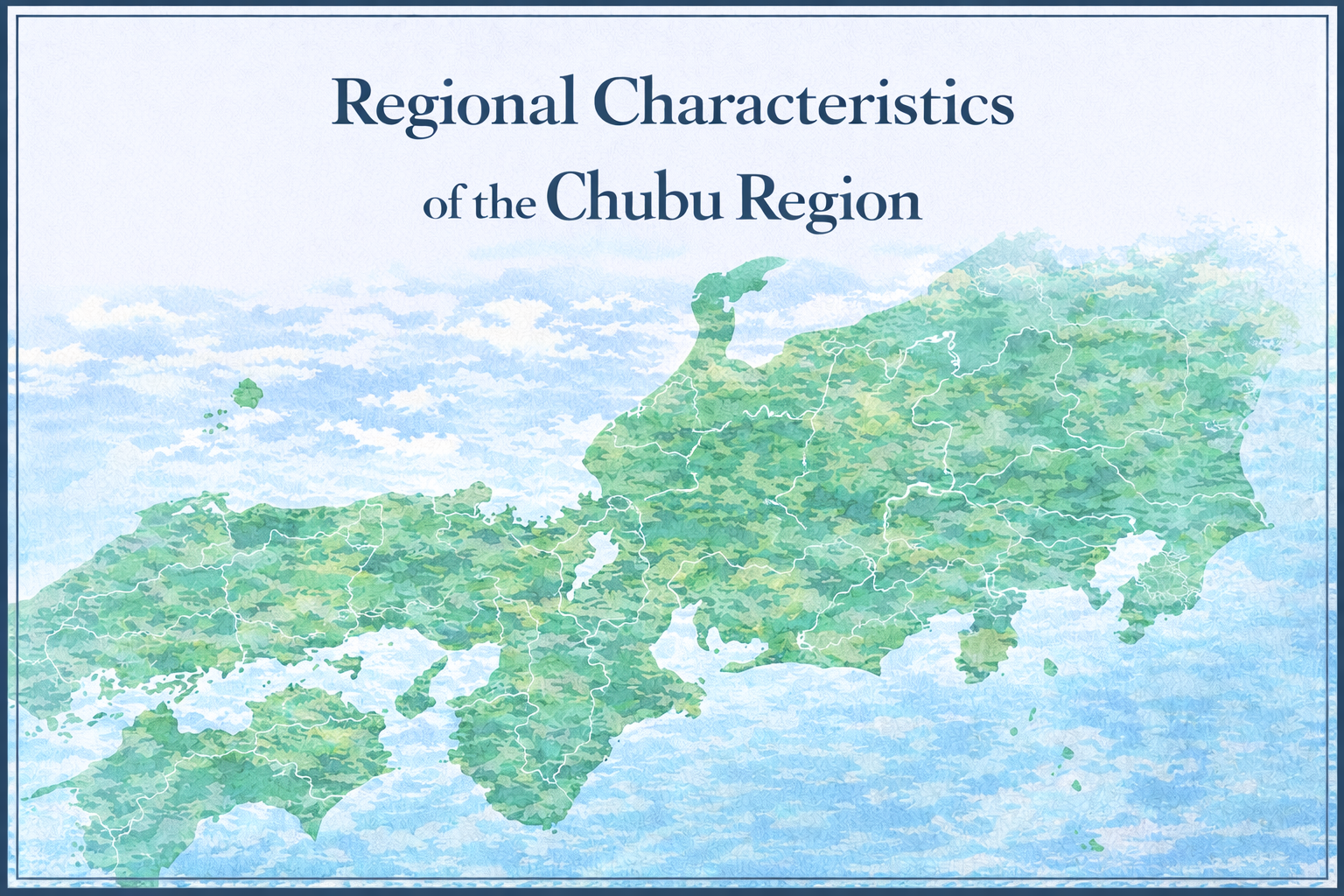
Overview of the Chubu Region
Area
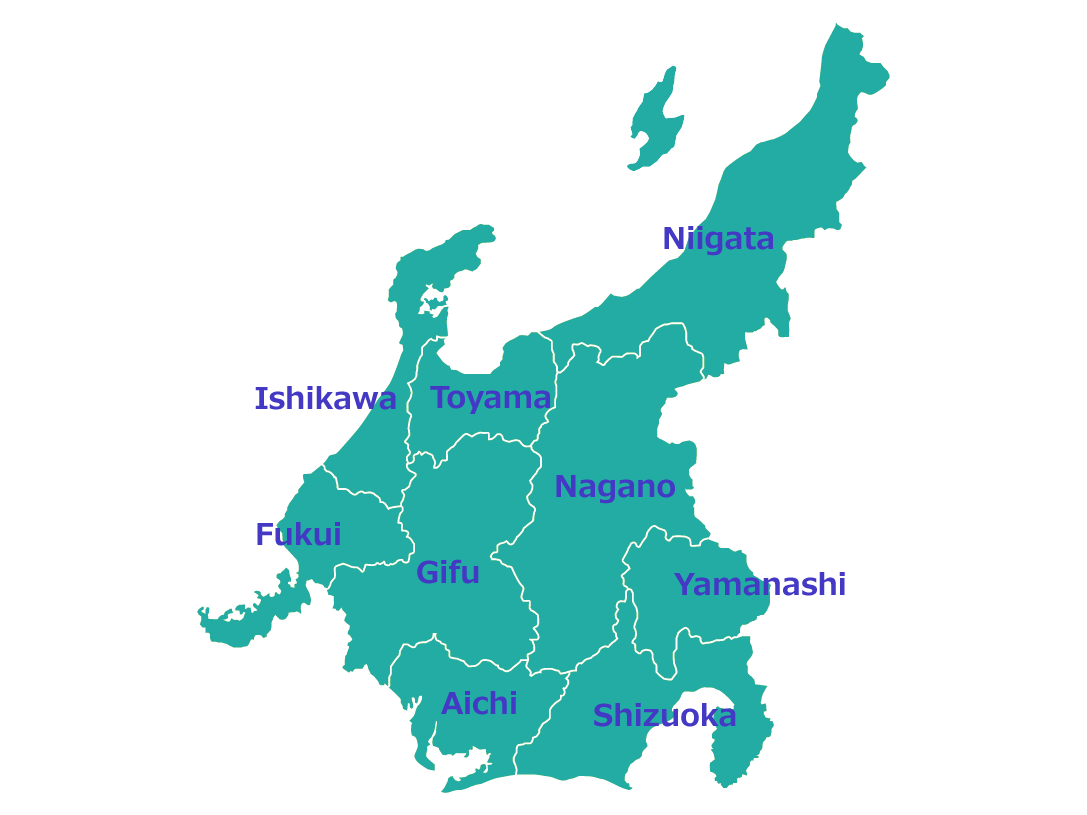
The Chubu region lies in the central part of Honshu, Japan’s main island, and covers about 66,000 square kilometers. It represents nearly 18% of Japan’s total land area, making it the country’s largest region by size.
Population
The population of the Chubu region is approximately 21 million. While large urban areas such as Nagoya, Niigata, and Shizuoka are densely populated, many mountainous and inland regions have smaller populations and aging demographics.
Location
Geographically, the Chubu region stretches between the Kanto region in the east and the Kinki region in the west. It borders the Sea of Japan on the north and the Pacific Ocean on the south. This region functions as a central connection point between eastern and western Japan.
Nature
Topography
The Chubu region is diverse in topography and is divided into three subregions based on natural features and climate:
- Hokuriku Region (Sea of Japan side)
- Central Highlands (Inland mountainous area)
- Tokai Region (Pacific side)
Hokuriku Region
The Hokuriku area faces the Sea of Japan and receives heavy snow in winter due to cold seasonal winds. It is rich in water resources and has developed large rice-producing areas.
Main geographical features:
- Shinano River (Japan’s longest river, flowing through Niigata Prefecture)
- Jinzu River (Toyama Prefecture)
- Kuzuryu River (Fukui Prefecture)
Central Highlands
This region is dominated by high mountain ranges collectively called the Japanese Alps, consisting of the Hida, Kiso, and Akaishi Mountains. Surrounded by highlands and basins, it features a large variation in altitude.
Main geographical features:
- Hida Mountains (Northern Alps): Steep peaks such as Mount Tateyama and Mount Hotaka.
- Kiso Mountains (Central Alps): Includes Mount Kisokoma.
- Akaishi Mountains (Southern Alps): Features Mount Kita and Mount Akaishi.
- Basins: Includes the Kofu, Matsumoto, and Suwa Basins, which are major residential and agricultural zones.
Tokai Region
Facing the Pacific Ocean, the Tokai region is a lowland area centered on wide plains and coastal belts. It is also an important industrial zone.
Main geographical features:
- Kiso, Nagara, and Ibi Rivers: Three major rivers forming the Nobi Plain.
- Nobi Plain: One of Japan’s largest plains, where Nagoya City is located.
- Mikawa Bay, Enshu-nada, Suruga Bay: Coastal zones rich in marine resources.
Climate
Hokuriku: Climate of the Sea of Japan Side
The Hokuriku region has a humid climate with heavy snowfall in winter. Rain and snow are frequent, while summer is hot and humid. The abundant rainfall supports rice cultivation.
Central Highlands: Inland Climate
The Central Highlands have an inland climate characterized by large temperature differences between day and night and between summer and winter. Summers are cool, and winters are cold and dry. Because rainfall is low, the region is suitable for fruit cultivation.
Tokai: Climate of the Pacific Side
The Tokai region has a Pacific Ocean climate with hot, humid summers and mild winters. Rainfall is concentrated in the rainy season and during typhoons. The mild weather supports the growth of tea, oranges, and other crops.
Industries
Agriculture and Fisheries
The Chubu region’s agriculture varies widely according to its climate and terrain.
Hokuriku
- A large-scale paddy field zone known as one of Japan’s “granaries.”
- Niigata rice is a nationally famous brand.
Central Highlands
- Apple cultivation in the Nagano Basin.
- Peaches and grapes grown in the Kofu Basin.
- High-altitude vegetable farming such as cabbage and lettuce using the “off-season cultivation” method.
Tokai
- Rice and vegetable farming on the Nobi Plain.
- Tea and mandarin oranges grown in Shizuoka Prefecture.
- Deep-sea fishing and tuna processing in Yaizu Port.
Industry
Hokuriku
- Hokuriku Industrial Region centered on Niigata, Toyama, and Fukui.
- Local industries include metal processing in Tsubame-Sanjo (Niigata) and pharmaceutical production in Toyama.
Central Highlands
- Precision machinery and optical instruments industries, particularly in Nagano and Yamanashi.
Tokai
- Chukyo Industrial Region centered on Nagoya.
- Automobile, aerospace, and machinery industries are major sectors.
- The region also plays a crucial role in Japan’s export economy through ports such as Nagoya and Shimizu.
Conclusion
The Chubu region exhibits the greatest diversity in geography and climate in Japan, ranging from snow-covered plains in the north to warm coastal areas in the south. Its mountains, rivers, and plains have shaped both traditional lifestyles and modern industries.
The region serves as a microcosm of Japan—where visitors can experience snow country, mountain villages, modern cities, and seaside towns all within a single area. Its blend of natural beauty and industrial development continues to define the heart of Japan.
Comments