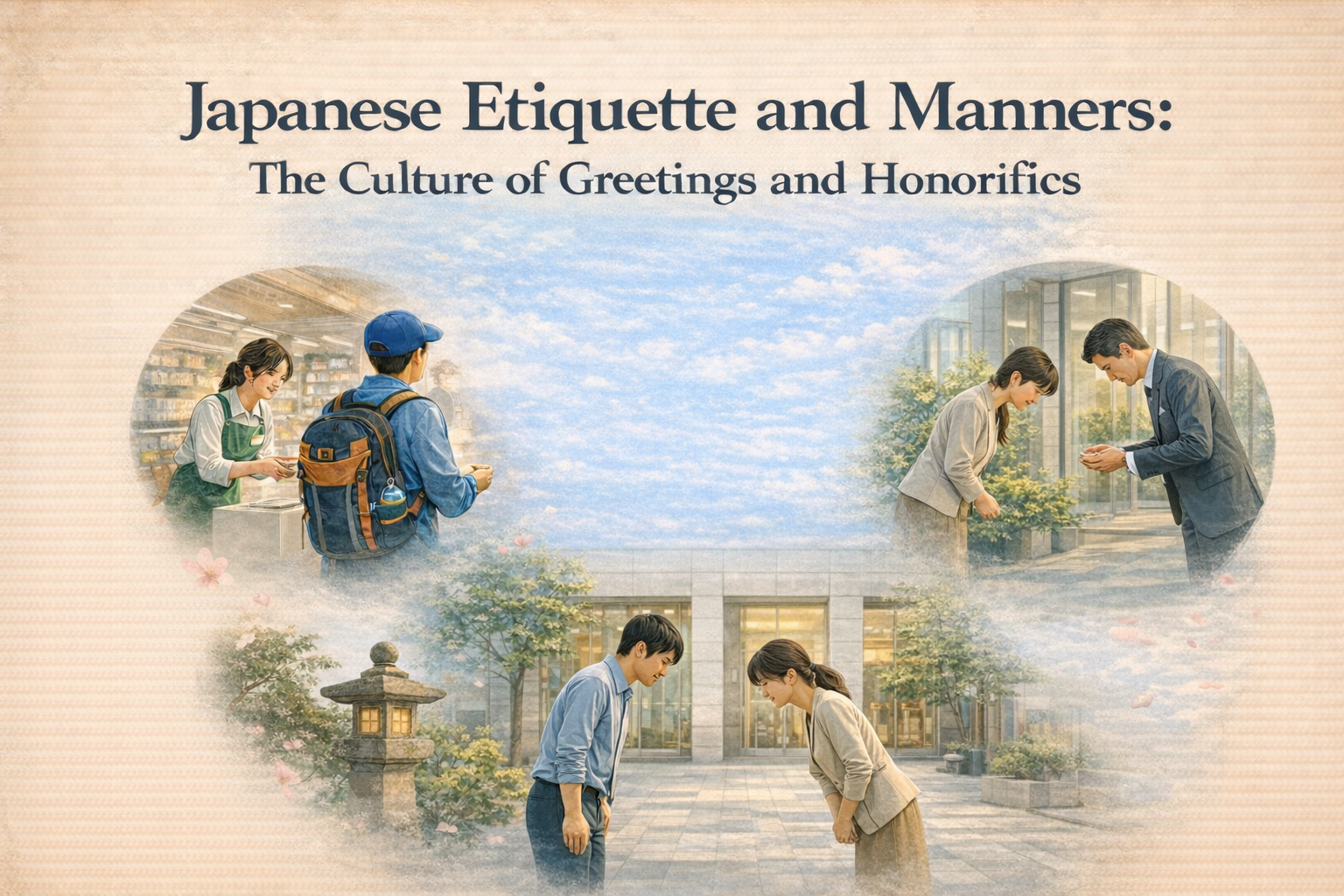
One of the first things many visitors notice in Japan is the importance of greetings and the way language changes depending on the relationship between speakers. Japanese includes many everyday expressions such as ohayou gozaimasu (good morning), konnichiwa (hello / good afternoon), and arigatou gozaimasu (thank you). These expressions are more than simple words. They help make social interaction smooth and respectful.
This article looks at Japanese greetings and honorific language, including some of their cultural background, how they are used in daily life, and how they may feel different from everyday English.
Japanese Greeting Culture and Background
Greetings as Descriptions of the Situation
One feature often noted in Japanese greetings is that many of them are closely connected to the situation at hand. For example, ohayou gozaimasu is associated with the idea of “being early” and is used as a morning greeting. In that sense, it can feel less like a personal wish and more like an acknowledgement of the moment being shared.
This kind of expression reflects a communication style that often pays close attention to the immediate setting and to the relationship between people. Rather than focusing only on the speaker’s intention, Japanese greetings often help confirm a shared social moment.
Similarly, konnichiwa and konbanwa are tied to the time of day. Even when their older forms are explained in more detail, what matters for modern learners is that these expressions are closely linked to the present situation and help create a polite opening for interaction.
Comparison with English Greetings
English greetings can feel slightly different. For example, “Good morning” may be understood as carrying a positive wish for the other person’s day. Japanese greetings, by contrast, are often explained in a way that places more emphasis on acknowledging the present moment and the relationship between speakers.
This does not mean that one language is warm and the other is not. Rather, the difference is in what the expression seems to highlight. English greetings may sound more directly expressive in some cases, while Japanese greetings often feel closely tied to social setting, timing, and shared awareness.
For that reason, learners may notice that greetings in Japan are not only about exchanging words. They also help establish tone, distance, and mutual recognition at the start of an interaction.
Agricultural Culture and Greetings
Japanese greeting culture also developed in a society shaped for a long time by agriculture and seasonal rhythms. Daily life was closely connected to time, weather, and cooperation within the local community. In that context, greetings were not only polite expressions but also part of everyday social coordination.
For example, in farming communities, work often depended on cooperation among neighbours. Greeting one another helped confirm trust, familiarity, and readiness to work together. In that sense, greetings had both a practical and a social role.
This background helps explain why greetings in Japan are often felt to be small but meaningful acts that support smooth human relationships.
Bowing and the Physical Side of Greetings
Another distinctive feature of Japanese greetings is that they are often accompanied by bowing. The depth of the bow may change depending on the situation. A light bow may be used in casual greetings, a deeper bow in more formal settings, and an even deeper bow when showing strong respect or apology.
For example, in business situations, a more formal bow may be used when meeting someone for the first time. In everyday situations, a lighter bow is often enough when greeting someone briefly or passing by.
In many Western settings, physical greetings such as handshakes are common. In Japan, bowing has long served as a way of showing respect while maintaining personal space. This reflects a social style in which consideration, distance, and courtesy are often closely connected.
Honorific Language and Cultural Background
The Three Main Types of Honorifics
Japanese honorific language is often divided into three broad categories:
- Sonkeigo (respectful language), which elevates the actions of the other person
- Kenjougo (humble language), which lowers the speaker’s own actions in relation to the listener
- Teineigo (polite language), which makes the overall tone more courteous
These are not simply alternative word choices. They help express social distance, respect, and the relationship between speakers.
Comparison with English
English does not have a system directly equivalent to Japanese honorific language. Instead, politeness is often expressed through wording, tone, and sentence structure. Phrases such as “Could you please…?” or “Would you mind…?” soften a request, and titles such as “Mr.” or “Ms.” can signal respect.
Japanese and English therefore show politeness in different ways. Japanese often makes relationships visible through grammar and verb choice, while English often relies more on phrasing and tone.
Historical Background
The development of honorific language in Japanese is closely connected to the country’s social history. In periods when rank and hierarchy were strongly emphasised, language became one of the ways to show position and respect. Over time, this also became linked to the broader cultural value of maintaining social harmony.
For example, in earlier formal societies, the way one spoke could reflect loyalty, humility, or appropriate distance. These historical patterns helped shape the forms of respectful language that remain important in Japan today.
Practical Examples in Daily Life
Convenience Stores and Restaurants
In convenience stores and restaurants, staff often greet customers with irasshaimase (welcome) and may say arigatou gozaimashita after payment or at the end of the interaction. These are not only routine service phrases. They also reflect a broader culture of politeness in public-facing situations.
Customers may respond with expressions such as onegaishimasu or gochisousama deshita, depending on the setting. Even short exchanges like these help create a respectful and orderly interaction.
Business Situations
In business settings, greetings and honorific language are especially important. When exchanging business cards, people may say yoroshiku onegai itashimasu, a polite phrase used when beginning a professional relationship. Cards are usually presented with both hands and received carefully.
These actions may seem formal at first, but they help show attentiveness and respect. In professional contexts, both language and physical manner are part of the greeting.
Family and Friends
Among family members and close friends, language is often much less formal. Polite endings may be dropped, and greetings may sound simpler and more direct. This does not mean the interaction is careless. On the contrary, reduced formality often signals closeness and familiarity.
In this way, Japanese honorific language is not used equally in all situations. Its use changes depending on distance, intimacy, and context.
Common Misunderstandings and Mistakes by Foreign Visitors
Foreign visitors sometimes run into small misunderstandings, such as:
- using an overly casual greeting in a formal setting
- introducing themselves without enough polite language in a business situation
- offering only a handshake in a context where a bow would feel more natural
These are usually not serious problems, but they can create slight awkwardness. In Japan, greetings and word choice are often seen as visible signs of respect, so understanding a few basic patterns in advance can make interaction easier.
Conclusion
The culture of greetings and honorifics in Japan is not only about vocabulary. It is also about showing respect, recognising social relationships, and helping interactions proceed smoothly. Greetings, bowing, and levels of polite language all play a role in this process.
English and Japanese do not express politeness in exactly the same way, and that difference can be interesting for visitors to notice. By understanding some of these patterns, readers can gain a deeper appreciation of Japanese culture and communicate with greater confidence and sensitivity.

Comments