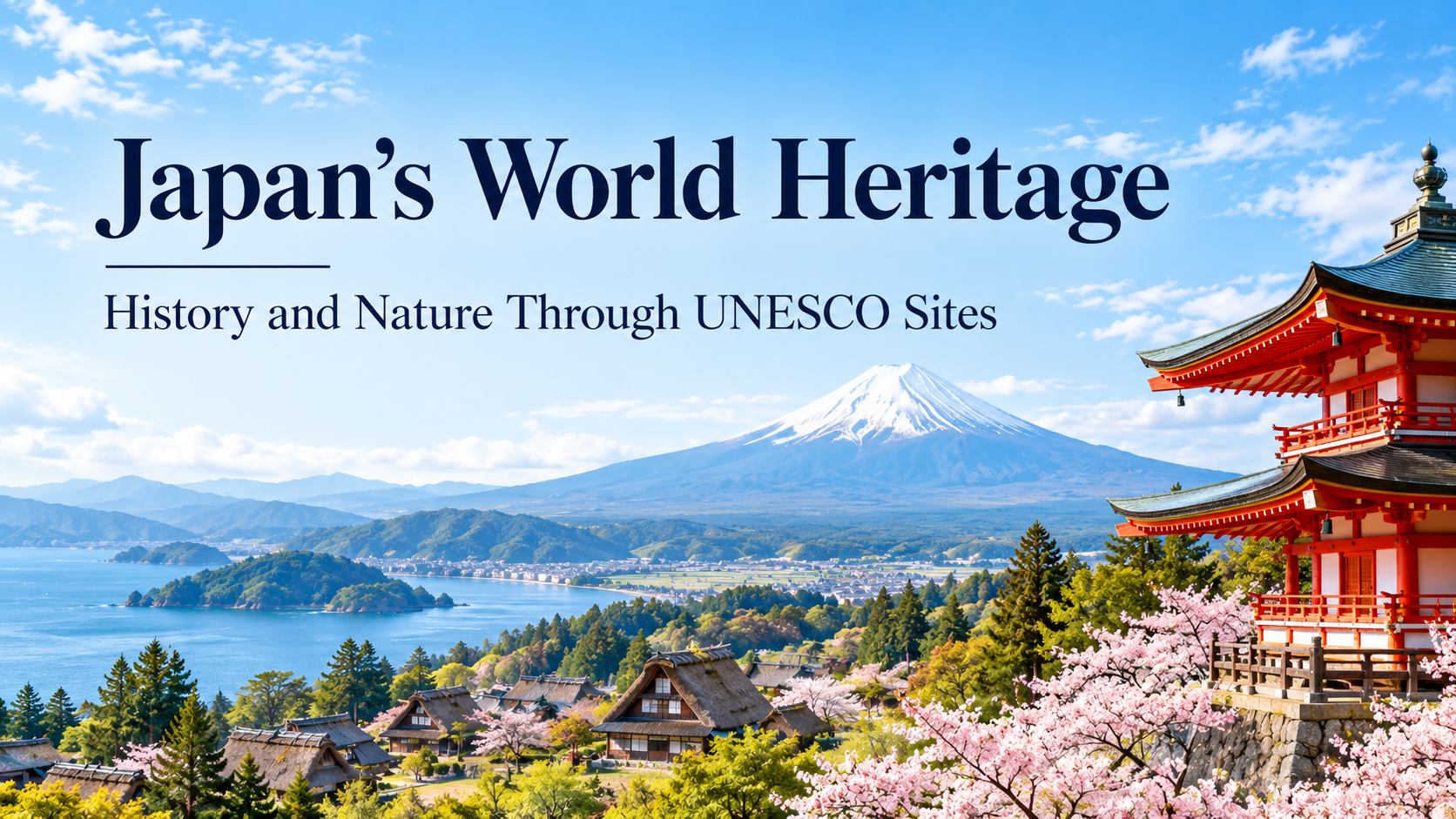
Mount Fuji was inscribed as a UNESCO World Cultural Heritage Site in 2013.
Its volcanic landscape and distinctive shape are widely known. For World Heritage purposes, UNESCO recognized its long history as a sacred mountain and its influence on art.
Shiretoko in Hokkaido was inscribed for a very different reason. Its marine ecosystem, shaped by seasonal sea ice, is closely connected with life on land. Salmon grow in the sea and return to rivers, where they become food for brown bears and other animals, carrying marine nutrients into the terrestrial ecosystem.
The reasons for World Heritage inscription vary greatly from one place to another.
As of September 2026, Japan has 27 World Heritage Sites: 22 cultural properties and five natural properties. The Ancient Capitals of Asuka and Fujiwara were added to the list in 2026.
Knowing why a site was inscribed gives travelers a clearer understanding of the history and natural environment behind the places they visit.
- What Does UNESCO Evaluate When Selecting World Heritage Sites?
- Mount Fuji Carries a Long History of Worship and Art
- Jomon and Kofun Sites Show Changes in Early Japanese Society
- From Asuka and Fujiwara to Nara and Kyoto, the History of Japan’s Capitals Continues
- Cultural Landscapes Reflect the Relationship Between People and Nature
- At Shirakawa-go, Snow and Daily Life Shaped the Houses
- Industrial Heritage Preserves the History of Japan’s Modernization
- In Shiretoko, Marine and Terrestrial Ecosystems Are Connected
- On Yakushima, Vegetation Changes from the Coast to the Mountains
- The Ogasawara Islands Show Evolution on Oceanic Islands
- The Southwestern Islands Preserve Distinctive Endemic Species
- Shirakami-Sanchi Preserves Beech Forests in a Snowy Region
- Japan Has 27 World Heritage Sites
- World Heritage Sites Also Have Rules Designed to Protect Them
- Looking at World Heritage Sites Through Their Reasons for Inscription
What Does UNESCO Evaluate When Selecting World Heritage Sites?
UNESCO uses the concept of “Outstanding Universal Value” when assessing World Heritage nominations.
A site must have significance for humanity as a whole, and measures must be in place to protect that value over the long term.
For cultural properties, UNESCO may evaluate the history preserved in buildings and archaeological remains. Traditional ways of life and cultures shaped by contact between different peoples can also contribute to a site’s significance.
For natural properties, ecosystems and geological features are among the main areas of evaluation. Some sites also preserve evidence of biological evolution over long periods.
At Shirakawa-go and Gokayama, traditional settlements developed in response to a snowy mountain environment and local livelihoods. At Itsukushima Shrine, the shrine buildings, the sea, and Mount Misen form a landscape shaped by centuries of religious belief.
The reason for inscription explains which qualities UNESCO considers especially important at each site.
Mount Fuji Carries a Long History of Worship and Art
Mount Fuji is officially inscribed as Fujisan, Sacred Place and Source of Artistic Inspiration.
For centuries, people have worshipped the mountain and climbed it as an act of religious devotion. Sengen shrines stand around its base, and many places in the surrounding area remain closely associated with Fuji worship.
During the Edo period, artists such as Katsushika Hokusai and Utagawa Hiroshige repeatedly depicted Mount Fuji. Their works later became widely known overseas and helped shape the international image of the mountain as a symbol of Japan.
The Mount Fuji seen today from lakeshores and viewpoints is also a mountain with a long history of worship and artistic representation.
Jomon and Kofun Sites Show Changes in Early Japanese Society
Some of Japan’s World Heritage Sites preserve evidence of societies that existed long before the Asuka period.
The Jomon Prehistoric Sites in Northern Japan consist of 17 archaeological sites in southern Hokkaido and northern Tohoku. People lived in permanent settlements while relying on hunting, fishing, and gathering, and this way of life continued for roughly 10,000 years. The sites preserve settlement remains as well as cemeteries and places associated with ritual activity.
In later centuries, large burial mounds were built across Japan.
The Mozu-Furuichi Kofun Group in Osaka preserves burial mounds dating from the 3rd to the 6th centuries. Differences in their size and form reflect the social hierarchy of the period and provide evidence of political organization before Japan developed a centralized state.
Seen in chronological order, the Jomon sites and kofun show how patterns of life and social organization changed over long periods of Japanese history.
From Asuka and Fujiwara to Nara and Kyoto, the History of Japan’s Capitals Continues
The Ancient Capitals of Asuka and Fujiwara, inscribed in 2026, consist of 19 component sites in the southern Nara Basin.
From the late 6th to the early 8th century, Japan developed a more centralized system of government. Remains of palaces and temples from this period survive in Asuka and Fujiwara.
Political systems and Buddhist culture developed through contact with China and the Korean Peninsula, while the form of the capital also changed. The political center later moved to Heijo-kyo in Nara and eventually to Heian-kyo in Kyoto.
Other Japanese World Heritage Sites include the Buddhist Monuments in the Horyu-ji Area and the Historic Monuments of Ancient Nara. Kyoto preserves many temples and shrines from the Heian period and later centuries.
Viewed in chronological order, these sites show how Japan’s early state took shape and how its capitals and religious culture developed over time.
Cultural Landscapes Reflect the Relationship Between People and Nature
UNESCO also recognizes the concept of the “Cultural Landscape.”
Introduced into the World Heritage framework in 1992, it refers to landscapes shaped over long periods through the interaction of people and nature. UNESCO describes them as the “combined works of nature and humankind.”
The Sacred Sites and Pilgrimage Routes in the Kii Mountain Range provide a clear example.
Sacred places such as Kumano Sanzan and Koyasan are included together with the pilgrimage routes that connect them.
In the Kii Mountains, the surrounding mountains and forests have long been closely associated with religious belief. Seeing the sacred sites and pilgrimage routes within this natural setting helps explain how mountain worship developed in the region.
The Iwami Ginzan Silver Mine also preserves a strong relationship between human activity and the surrounding landscape.
Routes extended from the mining areas toward port towns, while settlements and forests that supported the mine remain throughout the region.
Looking across the wider area from the mines to the coast reveals how the landscape supported silver production and transport.
At Shirakawa-go, Snow and Daily Life Shaped the Houses
Shirakawa-go and Gokayama offer another example of how the local environment shaped everyday life.
These mountain communities receive heavy snowfall in winter. The steeply pitched roofs of the traditional gassho-style houses developed in response to this climate and the way people lived there.
Silkworm cultivation was also carried out inside the houses, making use of the large attic spaces beneath the roofs. UNESCO recognizes the gassho-style houses as traditional dwellings adapted to the natural environment and to the social and economic conditions of the region.
Farmland and forests still surround the villages today.
Looking at the houses together with their surroundings shows how life in a snowy mountain region influenced both the architecture and the form of the settlements.
Industrial Heritage Preserves the History of Japan’s Modernization
Several of Japan’s cultural World Heritage Sites are connected with the development of modern industry.
At the Tomioka Silk Mill in Gunma Prefecture, technology from France was introduced in the 19th century to develop mechanized silk production. Raw silk produced in Japan became one of the country’s major exports.
The Sites of Japan’s Meiji Industrial Revolution include facilities related to iron production and shipbuilding in Kyushu, Yamaguchi, and other areas. They preserve evidence of the period when Japan adopted Western technology and developed modern industry.
The Sado Island Gold Mines, inscribed in 2024, are valued for the gold and silver production techniques developed before large-scale mechanization.
These industrial heritage sites also show how Japan’s modernization was connected with technologies introduced from overseas.
In Shiretoko, Marine and Terrestrial Ecosystems Are Connected
Seasonal sea ice reaches the waters around Shiretoko in eastern Hokkaido each winter.
These waters support high biological productivity and a rich food web.
Chum salmon and pink salmon grow in the ocean and later return to rivers to spawn. As they swim upstream, they become food for brown bears and other animals. Their remains are then used by other organisms.
Some of the nutrients carried by the salmon eventually enter the soil and surrounding forests.
In this way, salmon help connect Shiretoko’s marine ecosystem with life on land. This interaction is one of the important features recognized in its World Natural Heritage inscription.
On Yakushima, Vegetation Changes from the Coast to the Mountains
Yakushima in Kagoshima Prefecture has mountains reaching close to 2,000 meters in elevation.
The large difference in altitude between the coast and the interior creates distinct vegetation zones.
Subtropical plants grow near the coast. At higher elevations, warm-temperate forests appear, followed by cedar forests and high-elevation vegetation in the mountains.
Ancient Yakusugi cedars are the best-known symbol of the island. The continuous change in vegetation from the coast to the highlands is also an important feature of its World Natural Heritage value.
Traveling inland from the coast reveals how dramatically the forest changes with elevation within a single island.
The Ogasawara Islands Show Evolution on Oceanic Islands
The Ogasawara Islands lie about 1,000 kilometers south of central Tokyo.
Since their formation, they have remained isolated from continental landmasses.
The ancestors of the plants and animals found there reached the islands across the sea and then continued to evolve in isolation.
Many land snail species are endemic to the islands, and their distribution helps researchers study how different species developed on separate islands and in different environments.
Ogasawara provides a clear example of how geographic isolation can shape biological evolution.
The Southwestern Islands Preserve Distinctive Endemic Species
Amami-Oshima Island, Tokunoshima Island, Northern Okinawa Island and Iriomote Island were inscribed as a World Natural Heritage Site in 2021.
Subtropical forests cover much of these areas and provide habitat for endemic species such as the Amami rabbit.
Over long periods of geological change, populations of animals became isolated on individual islands. They continued to evolve under different conditions, producing distinctive communities of plants and animals.
This history helps explain why each island supports its own combination of endemic species.
Understanding how the islands formed provides important context for the biodiversity found there today.
Shirakami-Sanchi Preserves Beech Forests in a Snowy Region
Shirakami-Sanchi extends across Aomori and Akita prefectures and contains a large area of old-growth beech forest.
The region lies on the Sea of Japan side of northern Honshu and receives heavy snowfall in winter. The beech forests developed under these climatic conditions and now provide habitat for a wide range of plants and animals.
Species such as the black woodpecker and Asian black bear also live in the area.
Understanding Tohoku’s snowy climate helps explain the environment in which the forests of Shirakami-Sanchi developed. The World Heritage property protects the broader ecosystem centered on these beech forests.
Japan Has 27 World Heritage Sites
As of September 2026, Japan has 22 cultural World Heritage properties and five natural properties.
The cultural sites cover a wide span of history, from ancient Buddhist monuments to mines and modern industrial facilities. The natural sites extend from ecosystems shaped by seasonal sea ice in Hokkaido to subtropical forests in the southwestern islands.
The table below summarizes the significance of each site.
| Type | World Heritage Site | Year Inscribed | What It Preserves |
|---|---|---|---|
| Cultural | Buddhist Monuments in the Horyu-ji Area | 1993 | Early wooden Buddhist architecture dating from the 7th century onward, showing the early development of Buddhist architecture in Japan. |
| Cultural | Himeji-jo | 1993 | A major early 17th-century wooden castle complex with well-preserved architecture and defensive features. |
| Natural | Yakushima | 1993 | Ancient cedar forests and vegetation that changes dramatically from the coast to high mountain areas. |
| Natural | Shirakami-Sanchi | 1993 | A large old-growth beech forest across Aomori and Akita, preserving a forest ecosystem shaped by heavy snowfall. |
| Cultural | Historic Monuments of Ancient Kyoto | 1994 | Temples, shrines, and other monuments in Kyoto, Uji, and Otsu that preserve the architectural and garden traditions of Japan’s long-standing imperial capital. |
| Cultural | Historic Villages of Shirakawa-go and Gokayama | 1995 | Gassho-style houses and mountain settlements shaped by heavy snowfall and traditional sericulture. |
| Cultural | Hiroshima Peace Memorial (Genbaku Dome) | 1996 | A surviving structure from the 1945 atomic bombing of Hiroshima that preserves the memory of nuclear destruction and war. |
| Cultural | Itsukushima Shinto Shrine | 1996 | A sacred landscape where shrine buildings set over the water are closely connected with Mount Misen and the religious significance of the island. |
| Cultural | Historic Monuments of Ancient Nara | 1998 | Temples, shrines, and palace remains associated with Heijo-kyo, preserving the political and Buddhist culture of 8th-century Japan. |
| Cultural | Shrines and Temples of Nikko | 1999 | Religious architecture including Toshogu that reflects Tokugawa rule and the religious and artistic culture of the Edo period. |
| Cultural | Gusuku Sites and Related Properties of the Kingdom of Ryukyu | 2000 | Castle ruins and sacred sites that preserve the political and religious culture of the Ryukyu Kingdom and its connections with East Asia. |
| Cultural | Sacred Sites and Pilgrimage Routes in the Kii Mountain Range | 2004 | Sacred mountains and pilgrimage routes that preserve a long tradition of worship connected with the natural landscape of the Kii Peninsula. |
| Natural | Shiretoko | 2005 | An ecosystem linking seasonal sea ice and marine life with salmon and terrestrial wildlife such as brown bears. |
| Cultural | Iwami Ginzan Silver Mine and its Cultural Landscape | 2007 | Mining remains, settlements, transport routes, and ports that preserve the wider landscape of silver production and distribution. |
| Cultural | Hiraizumi – Temples, Gardens and Archaeological Sites Representing the Buddhist Pure Land | 2011 | Temples and gardens expressing Pure Land Buddhism and the distinctive culture that flourished in northern Japan during the 11th and 12th centuries. |
| Natural | Ogasawara Islands | 2011 | Oceanic islands with many endemic species shaped by long-term evolution in geographic isolation. |
| Cultural | Fujisan, Sacred Place and Source of Artistic Inspiration | 2013 | The history of worship and pilgrimage associated with Mount Fuji and its influence on art, including ukiyo-e. |
| Cultural | Tomioka Silk Mill and Related Sites | 2014 | The development of modern silk production in Japan and the exchange of industrial technology with Europe. |
| Cultural | Sites of Japan’s Meiji Industrial Revolution | 2015 | Industrial sites associated with iron production and shipbuilding that preserve the rapid development of modern industry in Japan. |
| Cultural | The Architectural Work of Le Corbusier | 2016 | Part of a transnational collection of Le Corbusier’s architecture; Japan is represented by the National Museum of Western Art in Tokyo. |
| Cultural | Sacred Island of Okinoshima and Associated Sites in the Munakata Region | 2017 | Ancient rituals on Okinoshima and the Munakata faith, reflecting maritime travel and contact with the Asian continent. |
| Cultural | Hidden Christian Sites in the Nagasaki Region | 2018 | Settlements and sacred places associated with communities that maintained Christian beliefs during the period of prohibition. |
| Cultural | Mozu-Furuichi Kofun Group | 2019 | Burial mounds dating from the 3rd to the 6th centuries that reflect social hierarchy and political power during the Kofun period. |
| Natural | Amami-Oshima Island, Tokunoshima Island, Northern Okinawa Island and Iriomote Island | 2021 | Subtropical forests with many endemic species shaped by long periods of geographic isolation. |
| Cultural | Jomon Prehistoric Sites in Northern Japan | 2021 | Archaeological sites preserving around 10,000 years of settled hunter-gatherer life and spiritual culture. |
| Cultural | Sado Island Gold Mines | 2024 | Mining and processing techniques developed mainly during the Edo period, preserving a sophisticated pre-mechanized system of gold and silver production. |
| Cultural | Ancient Capitals of Asuka and Fujiwara | 2026 | Nineteen component sites including palaces, temples, and burial mounds that preserve the development of Japan’s early centralized state. |
Taken together, the 27 sites cover a broad span of Japanese history and natural environments.
Jomon sites preserve the lives of early settled hunter-gatherer communities, while kofun burial mounds reflect later changes in social organization. From Asuka and Fujiwara through Nara and Kyoto, several World Heritage properties trace the development of the state and its capitals.
Industrial sites from later periods preserve changes in technology and production.
Among the natural properties, Shiretoko preserves connections between marine and terrestrial ecosystems. Yakushima shows how vegetation changes with elevation, while Ogasawara and the southwestern islands preserve different patterns of biological evolution.
World Heritage Sites Also Have Rules Designed to Protect Them
Protection and management continue after a site has been inscribed.
Some of these measures directly affect travelers.
One example is the route to Jomon Sugi on Yakushima.
From March 1 to November 30, private vehicles are restricted from accessing the Arakawa trailhead to reduce traffic, congestion, and environmental pressure in the mountain area. During this period, visitors use designated buses or other authorized transport.
Natural World Heritage areas may also have local rules governing trails and access to sensitive areas. Cultural properties require continuing work to preserve historic buildings and their surroundings.
Checking official visitor information before traveling also helps explain the purpose of local access rules and transport restrictions.
Looking at World Heritage Sites Through Their Reasons for Inscription
Mount Fuji carries a history of worship and artistic representation. In Shiretoko, salmon connect the marine ecosystem with life on land.
The gassho-style houses of Shirakawa-go reflect life in a snowy mountain region. At Iwami Ginzan, the routes linking the mines with settlements and ports still show how silver moved through the region.
Jomon archaeological sites preserve evidence of settled hunter-gatherer communities, while the kofun reflect later changes in social organization. From Asuka and Fujiwara through Nara and Kyoto, the development of capitals and government can also be followed over time.
The reasons for World Heritage inscription show how people lived in each region and how its natural environment developed.
Knowing those reasons before a visit gives context to the buildings, landscapes, and ecosystems seen on the ground.
Sources and Further Reading
- UNESCO World Heritage Centre, Japan – Properties inscribed on the World Heritage List
- UNESCO World Heritage Centre, Jomon Prehistoric Sites in Northern Japan
- UNESCO World Heritage Centre, Mozu-Furuichi Kofun Group: Mounded Tombs of Ancient Japan
- UNESCO World Heritage Centre, Ancient Capitals of Asuka and Fujiwara
- UNESCO World Heritage Centre, Cultural Landscapes
- UNESCO World Heritage Centre, Historic Villages of Shirakawa-go and Gokayama
- UNESCO World Heritage Centre, Sacred Sites and Pilgrimage Routes in the Kii Mountain Range
- UNESCO World Heritage Centre, Iwami Ginzan Silver Mine and its Cultural Landscape
- UNESCO World Heritage Centre, Shiretoko
- Ministry of the Environment, information on Yakushima and the Jomon Sugi trekking route
- Ministry of the Environment, information on Shiretoko
- Ministry of the Environment, information on Shirakami-Sanchi
- Ministry of the Environment, information on the Ogasawara Islands
- Ministry of the Environment, information on Amami-Oshima Island, Tokunoshima Island, Northern Okinawa Island, and Iriomote Island