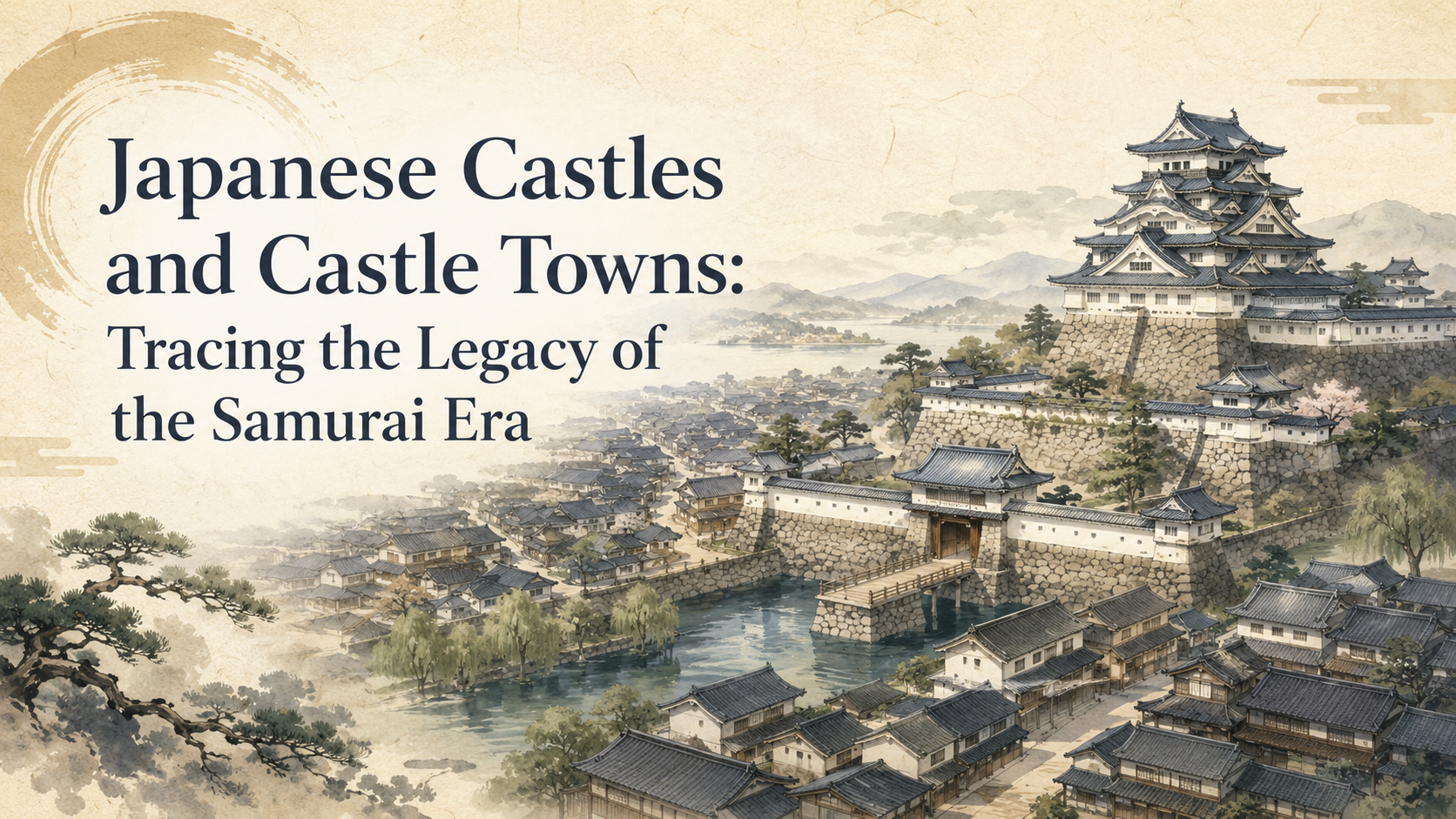
When traveling around Japan, you may come across castles with surviving keeps, castle ruins where only stone walls remain, or castle towns where the old street layout can still be felt. Castles are widely known as symbols of the samurai era, but they were not simply built for battle.
Castles served as military bases, but they were also centers of politics, administration, economy, and transportation. Around them, samurai, merchants, craftsmen, temples, and shrines gathered, forming castle towns. In today’s streets, place names, winding roads, moats, and stone walls, traces of urban planning from the age of the samurai still remain.
This article explores Japanese castles and castle towns as a way to trace the society and everyday life of the samurai era.
- What Is a Japanese Castle?
- Castles in the Warring States Period and Defensive Design
- Edo-Period Castles and Their Role in an Age of Peace
- How Castle Towns Were Created
- Samurai Residences and Townspeople’s Lives
- Defensive Wisdom in Castle Design
- The Appeal of Castles and Castle Towns Today
- What Castles and Castle Towns Reveal About the Samurai Era
- Conclusion
What Is a Japanese Castle?
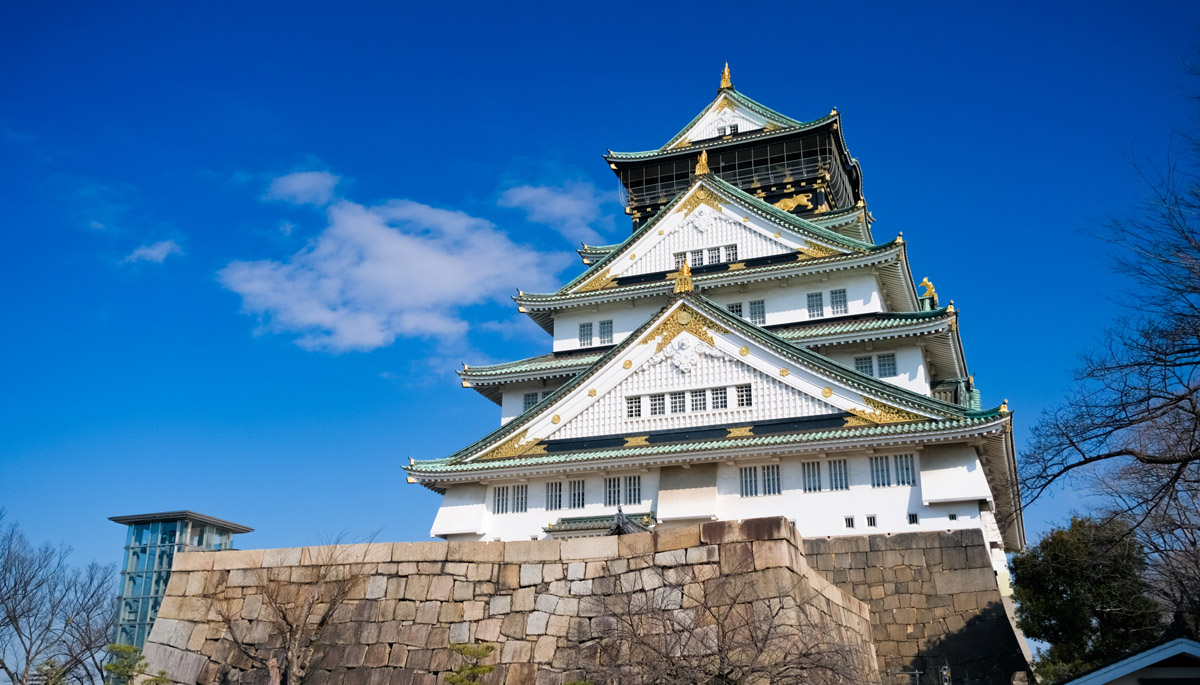
When people think of Japanese castles, many imagine a castle keep with white walls and tiled roofs. However, the original role of a castle was not only to create visual beauty.
A castle was a defensive facility that protected against enemies, and also a base for governing a region. Depending on the terrain, castles took many forms, including mountain castles built on mountains, flatland castles built on plains, and hill castles that made use of hills or plateaus.
In times of frequent warfare, castles had strong military significance. They were built on mountains or hills with good visibility, and moats, earthworks, stone walls, and gates were designed to prevent enemy intrusion. As time passed, castles developed not only as places for fighting, but also as centers of regional rule.
For this reason, when looking at a castle, it is worth paying attention not only to the keep, but also to the moats, stone walls, gates, baileys, and location. These features reveal how samurai tried to protect and govern their regions.
Castles in the Warring States Period and Defensive Design
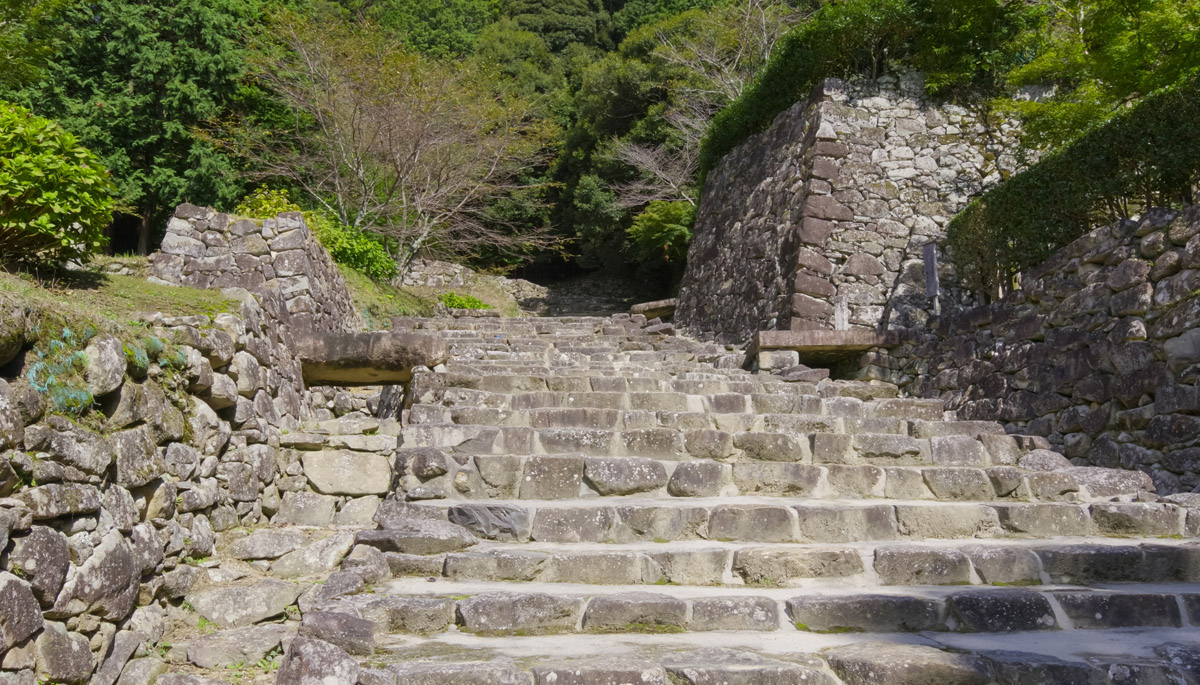
During the Warring States period, daimyo across Japan built many castles to defend their territories and expand their power. Castles of this era placed great importance on practical readiness for battle.
Mountain castles were a representative form. By making use of mountainous terrain, they made it difficult for enemies to climb upward and were suitable for lookout and defense. Within the castle, flat sections called kuruwa were created, and earthworks and dry moats were used to block enemy movement.
In the latter part of the Warring States period, castles became larger and more systematically planned. Stone walls were built, broad castle compounds were developed, and vassals and merchants were gathered around the castle. Castles changed from military bases into centers of territorial rule.
Oda Nobunaga’s Azuchi Castle is well known as a symbolic example of this transformation. A castle with a tall keep showed not only military power, but also the authority of the ruler. Castles came to be not only places of defense, but also places where power was displayed.
Edo-Period Castles and Their Role in an Age of Peace
When Tokugawa Ieyasu established the Edo shogunate, Japan entered a long period of peace. In the Edo period, castles increasingly became centers for political and administrative work within each domain, rather than front-line military bases.
Daimyo governed their territories from castles. Within and around the castle, domain offices were established, and tasks such as managing annual rice taxes, maintaining public order, controlling retainers, and administering the region were carried out. Castles were core institutions that supported domain rule.
During the Edo period, the shogunate strictly controlled the construction and repair of castles. If a daimyo increased or strengthened castles on his own, it could be seen as a suspicious political or military move.
A symbolic policy was the “One Castle per Province” decree, issued in 1615. This order required daimyo, in principle, to dismantle castles other than their main residence castle. During the Warring States period, many castles and fortifications had existed across Japan, but in the Edo period, castles came to be positioned not as numerous military bases scattered throughout a region, but as limited centers of domain rule.
Through this change, castles shifted from facilities prepared for warfare to places that symbolized administration and rule in an age of peace. The fact that castle towns such as Hagi, Matsue, Aizuwakamatsu, and Hikone still preserve memories of towns centered around a single castle is deeply connected with these Edo-period castle policies.
Edo-period castles also expressed the status order of the samurai class. Residences of higher-ranking samurai were often located close to the castle, while residences of lower-ranking samurai and townspeople’s districts spread farther away. In this way, the structure of the castle town reflected differences in status and social role.
How Castle Towns Were Created
A castle town is a town formed around a castle. Around the castle, samurai residences, merchant and artisan districts, temples and shrines, highways, and moats were arranged.
The basic design of a castle town was shaped by ideas of defense and governance. Roads were bent, moats and rivers were used, and temples and shrines were placed at important points so that enemies could not easily approach the castle. When walking through a castle town today, you may notice roads that bend in unexpected ways or old place names that have survived. These are traces of town planning prepared for times of conflict.
One especially noteworthy element is the tera-machi, or temple district. Tera-machi refers to an area where temples were gathered together. In castle towns, temples were sometimes concentrated near entrances from major roads or around the outer edges of the town, where defense was important.
Temples had spacious grounds, gates, walls, and temple halls, and could also accommodate many people. For this reason, in times of emergency, they could serve as defensive bases. Temple districts were not only spaces of worship. They also had defensive meaning within the urban planning of castle towns.
Seen in this way, castle towns were not simply towns that grew naturally around castles. Samurai residences, merchant districts, artisan areas, temple districts, highways, moats, and rivers were combined to create urban spaces where defense, administration, and daily life overlapped.
At the same time, castle towns were also economic centers. Merchants and craftsmen gathered there, providing goods and services that supported samurai life. Blacksmiths, dyers, sake brewers, rice merchants, and many other groups helped develop towns connected to local industries.
Castle towns were not towns for samurai alone. Samurai handled politics and administration, townspeople supported commerce and handicrafts, and temples and shrines played roles in worship and local society. Together, these elements formed an urban space centered on the castle.
Samurai Residences and Townspeople’s Lives
In many castle towns, samurai residential areas and townspeople’s residential areas were laid out separately. Samurai served their lords and worked for the castle or domain. For this reason, the residences of high-ranking samurai were often placed near the castle or in important locations.
Samurai residences differed in scale according to rank and office. The gate, walls, garden, and size of the residence reflected the position of the household. When visiting surviving samurai residence sites today, we can see that samurai were not merely warriors. They had households, held official positions, and lived within local society.
In townspeople’s districts, merchants and craftsmen lived and worked. Townhouses were often built with shops facing the street, while living spaces and workshops were located farther inside. Townspeople in castle towns not only supported samurai life, but also played an important role in sustaining the local economy.
As the Edo period progressed, commerce and culture developed, and festivals, performing arts, food culture, and crafts also grew within castle towns. Castle towns are popular as tourist destinations today not only because of the castles themselves, but also because layers of townspeople’s culture and local life remain there.
Defensive Wisdom in Castle Design
Japanese castles contain many devices to prevent enemy intrusion. Stone walls, moats, gates, turrets, and baileys were not only visually impressive. They were also practical defensive systems.
Moats were built to obstruct enemy movement. Some were water-filled moats, while others were dry moats. Stone walls made the castle appear higher, but they also functioned as walls that were difficult for enemies to climb. Depending on the location, the way stones were stacked and the angle of the walls also show careful design.
Castle gates also included devices for stopping the momentum of attacking enemies. A representative structure is the masugata. A masugata is a square enclosure placed beyond a gate, where the path turns at a right angle. Enemies could not advance straight into the castle, but were instead led into a confined space. Their movement was slowed or stopped, and they became vulnerable to attack from the surrounding stone walls and turrets.
This structure was not only for blocking enemies. It also changed the direction of movement, interrupted lines of sight, and prevented visitors from immediately seeing what lay ahead. Japanese castles often used methods that controlled movement and vision rather than simply meeting force with force.
The fact that paths inside castles are often not straight, but instead bend and twist, is also related to defense. When walking through a castle, paying attention to the direction of gates and the bends in the paths makes the defensive wisdom of the time more concrete.
The Appeal of Castles and Castle Towns Today
Today, many castle ruins and castle towns remain throughout Japan. Some castles have surviving keeps, while others have reconstructed keeps, stone walls and moats, or mountain ruins deep in the landscape.
At castles with surviving keeps, visitors can experience historical building techniques and the atmosphere of the original spaces. Himeji Castle, Matsumoto Castle, Hikone Castle, Inuyama Castle, and Matsue Castle are well known for their historical value. At the same time, even castle ruins without surviving keeps have many points of interest, including stone walls, moats, baileys, and the layout of the surrounding castle town.
In castle towns, visitors can enjoy walking through old townhouses, samurai residences, temple districts, merchant houses, and traces of historical roads. Places such as Kanazawa, Hagi, Matsue, Aizuwakamatsu, Hikone, and Inuyama make it easier to sense the relationship between castle and town.
When visiting castles and castle towns, it is worth looking beyond the famous keep and paying attention to the formation of the town as a whole. By tracing the relationship between the castle and the town below, the locations of samurai residences, the streets of merchant districts, the placement of temples and shrines, and old place names, the urban structure of the samurai era begins to emerge.
What Castles and Castle Towns Reveal About the Samurai Era
Castles and castle towns are important clues for understanding the age of the samurai. A castle was a military base, a political center, and a place that displayed the authority of the ruler. A castle town was an urban space where samurai, townspeople, craftsmen, temples, and shrines each played their own roles.
Castles of the Warring States period preserve the tension of preparation for battle. Edo-period castles and castle towns reflect administration, status order, commerce, and cultural development in an age of peace. Looking at a castle is not only about looking at a building. It is also about looking at the structure of local society itself.
In present-day Japanese towns, traces of the samurai era remain in unexpected forms. Curving roads, old place names, moat remains, stone walls, temple districts, and samurai residence sites all tell us that towns were once created around castles.
Conclusion
Japanese castles and castle towns are cultural heritage that preserve the politics, military systems, economy, and daily life of the samurai era. Castles were facilities for warfare, but they were also centers for governing regions. Castle towns were places where not only samurai, but also merchants, craftsmen, temples, and shrines gathered and supported local society.
During the Warring States period, many castles were built as bases for defending territory. In the Edo period, policies such as the One Castle per Province decree greatly changed the role of castles, and they were developed as centers symbolizing domain administration and rule.
When visiting a castle, paying attention not only to the beauty of the keep but also to the stone walls, moats, gates, masugata, town layout, samurai residences, temple districts, and merchant areas allows the samurai era to appear in a more layered way.
Walking through Japanese castles and castle towns is not simply about seeing old buildings. It is also a journey through the terrain, roads, and memories of towns shaped by the history and culture of the samurai era.