When discussing Japanese culture, the word wa is extremely important. It appears in many terms associated with Japan, such as washoku (Japanese cuisine), washitsu (Japanese-style room), wafuku (Japanese clothing), wafū (Japanese style), and wa no kokoro (the spirit of harmony). However, wa is not simply a word that means “Japanese.”
Wa contains several overlapping meanings: maintaining peaceful relationships between people, bringing different elements into balance rather than allowing them to clash, and being aware of one’s connection with nature and space.
From outside Japan, Japanese society is often seen as polite and as a culture that values group harmony. The idea of wa provides an important clue for understanding this background.
This article explores the meaning of wa in Japanese culture through human relationships, daily life, aesthetics, and the Japanese view of nature.
The Meaning of the Word Wa
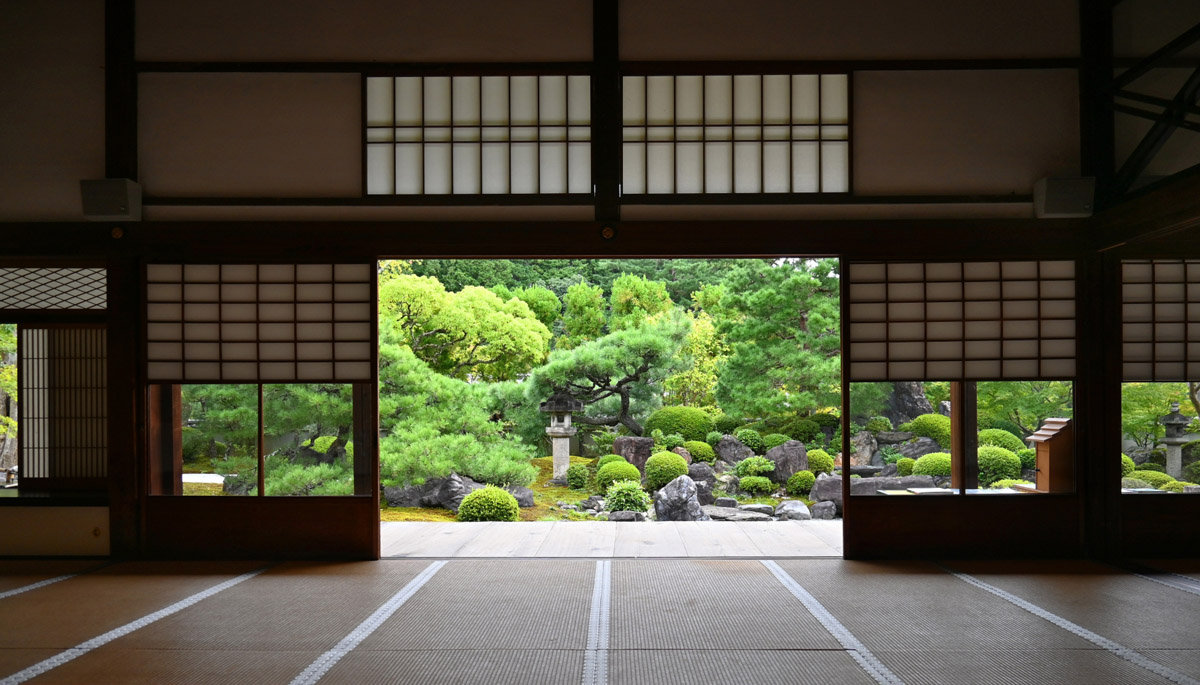
A Japanese-style room connects interior space with natural light, seasonal views, and the garden outside.
The character 和 carries meanings such as peace, harmony, softening, avoiding conflict, and coming together calmly. In Japan, this word has long been used when thinking about human relationships and the structure of society.
Wa is also used to represent Japan itself. Washoku refers to Japanese food culture, wafuku refers to traditional Japanese clothing, and washitsu refers to a Japanese-style room with tatami mats and sliding doors. In this sense, wa is both an idea of harmony and a word that symbolizes Japanese culture.
However, if we understand wa only as “making everyone the same,” the meaning becomes too narrow. Wa is not about erasing differences. It is closer to the idea of allowing different things to exist together without excessive conflict, while maintaining balance within a shared space or relationship.
People and people, nature and buildings, seasons and daily life, individuals and groups: wa includes the sense of creating a natural relationship among these different elements.
Ancient Japan and the Idea of Wa
When discussing the idea of wa in Japan, one phrase often mentioned is wa o motte tōtoshi to nasu, from the Seventeen-Article Constitution attributed to Prince Shōtoku. In English, it is often translated as “Harmony is to be valued.”
This phrase becomes too narrow if it is understood only as “avoid disagreement and simply obey.” The Seventeen-Article Constitution also includes the idea that important matters should not be decided by one person alone, but should be discussed carefully by everyone involved. In this sense, wa can be understood not as the absence of opinion, but as the creation of order through discussion and exchange.
In ancient politics and society, people in different positions were expected to express their views while maintaining order as a whole. At that time, Japan was developing its political system while adopting Buddhism, Confucian ideas, and institutions from the Asian continent. Within this process, wa came to be positioned as a basic idea for bringing people together.
Of course, ancient wa cannot be understood exactly in the same way as modern social harmony. Even so, Japanese culture has long valued the idea of not leaving conflict unresolved, but instead adjusting relationships through dialogue and coordination.
Wa in Human Relationships
The idea of wa appears most clearly in human relationships. In Japan, people have long valued choosing words while considering the other person’s position and feelings. Even when expressing an opinion, people may avoid strongly rejecting the other person and instead communicate in a somewhat indirect way.
For example, in a meeting or everyday conversation, rather than saying clearly, “I disagree,” someone might say, “There may be another way to think about it,” or “It might be worth considering this a little more.” This is not simply vagueness. It is also a way to express an opinion while avoiding unnecessary damage to the relationship.
Greetings, bowing, gift-giving, waiting one’s turn, and keeping one’s voice down in public spaces are also connected with wa. The idea is not that only one person should be comfortable, but that everyone sharing the same space can remain calm and at ease. This sensibility is deeply rooted in Japanese social life.
At the same time, a culture that values wa also has its difficulties. People may become so concerned about their relationships with others that they miss the timing to express their own opinions, or they may keep problems inside rather than bringing them into the open. For this reason, wa should not be understood as simple endurance. It is better understood as a way of arranging relationships while respecting the positions of others.
Wa and Etiquette
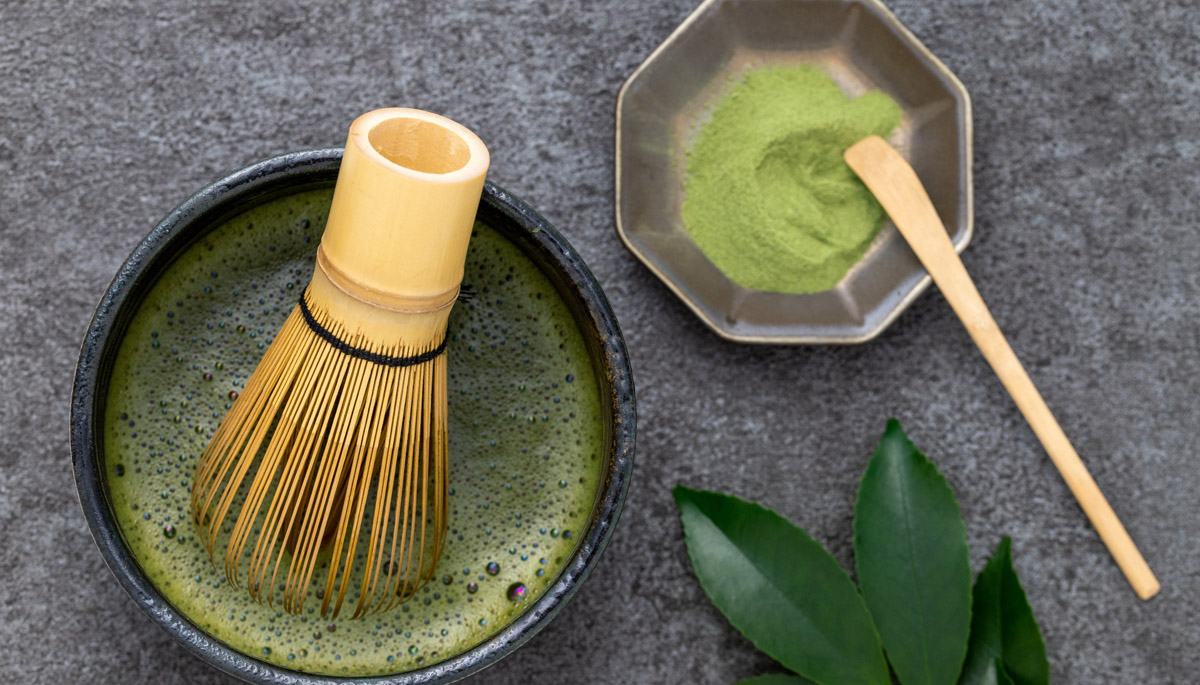
In the tea room, tools, movement, sound, light, and empty space come together to create quiet harmony.
Japanese etiquette often reflects the idea of wa. Etiquette is not simply about mechanically following detailed rules. It is also a form that helps people measure distance from others, avoid making others uncomfortable, and maintain peaceful relationships.
Bowing is a representative example. A bow can express greeting, gratitude, apology, respect, and many other meanings. When we see bowing not only as a gesture, but as an act that adjusts the relationship between people through movement, the meaning of Japanese etiquette becomes clearer.
Tea ceremony, flower arrangement, and martial arts also contain forms of etiquette. The way one enters a tea room, handles tools, speaks to others, and greets others at the beginning and end of practice all have meaning. These forms help people respect one another, avoid disturbing the atmosphere of the place, and share a single space.
Japanese etiquette may look complex from the outside. Yet beneath it is the sensibility of wa: arranging the relationship between oneself and others, and between the individual and the place.
Wa in Daily Life
Wa is not found only in special rituals or traditional arts. It also appears in everyday life.
A Japanese-style room is one example. A washitsu, made with tatami mats, shōji screens, fusuma sliding doors, and sometimes a tokonoma alcove, has a flexible quality. Furniture is not fixed too firmly in place, and the space can be changed depending on its purpose. It may be used as a guest room during the day and as a bedroom at night by laying out futon bedding.
Shōji screens bring outside light into the room softly. They also allow people to enjoy the greenery of the garden and the changes of the seasons from inside. Rather than completely separating the room from the garden, or the inside from the outside, the space connects them gently. This is one aspect of the spatial sensibility of wa.
This connection is not limited to visible scenery. The sound of rain, the sound of wind, the voices of insects, and the movement of garden trees can also enter the home softly. In Japanese houses, there has been a tendency not to shut out the sounds of nature completely, but to accept them as background sounds that announce the season.
This sensibility is also connected with the Japanese soundscape. The sound of wind chimes, wooden geta sandals, dripping rain, and temple bells has often been received not as mere noise, but as part of the atmosphere of a season or place. Accepting the outside environment quietly into daily life, rather than rejecting it, also reflects the spirit of wa.
The dining table also shows the idea of wa. In Japanese cuisine, rice, soup, a main dish, and side dishes are combined with attention to balance in taste, color, tableware, and seasonality. Food is not understood only by the size or richness of a single dish, but as an arrangement of the whole meal.
In this way, wa is connected not only with human relationships, but also with housing, food, tools, and the enjoyment of the seasons.
Harmony in Japanese Cuisine
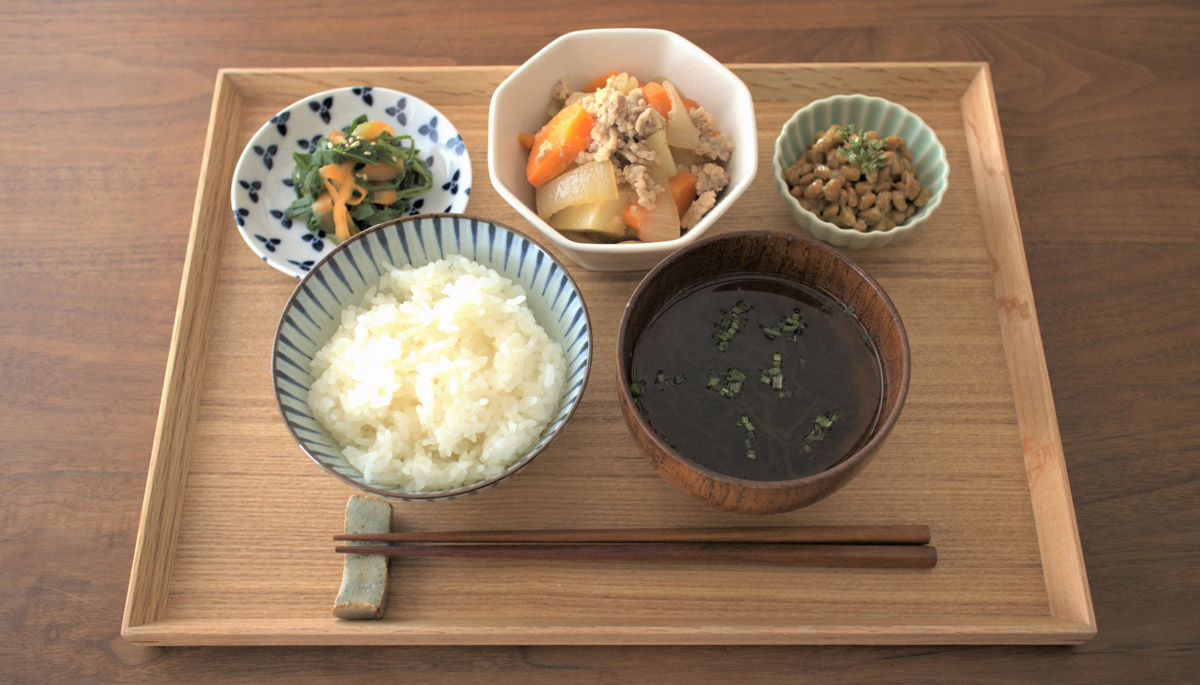
A traditional Japanese meal creates balance through rice, soup, main dishes, side dishes, tableware, and seasonality.
In Japanese cuisine, wa appears not only in flavor, but also in the arrangement of dishes and the way food is eaten. A representative form is ichijū-sansai, or “one soup and three dishes.” By combining rice, soup, a main dish, and side dishes, a meal creates balance in flavor, nutrition, appearance, and seasonality.
In Western course meals, dishes are often served one at a time, and the meal is structured through the flow of time. In Japanese meals, by contrast, several dishes are often placed together on the same tray or table, and the diner moves between them little by little.
With rice at the center, the diner moves between soup, grilled dishes, simmered dishes, pickles, and other foods, creating balance in the mouth with each bite. The dishes do not necessarily stand alone as complete units. Instead, the whole meal is shaped through the arrangement of vessels, the order of eating, and the way each dish combines with rice.
The harmony of Japanese cuisine is not found only on the plate. It includes the material of the tableware, the empty space in presentation, seasonal ingredients, and the arrangement of the entire table. This “harmony of placement” is connected with the way Japanese rooms and gardens are composed.
Harmony with Nature
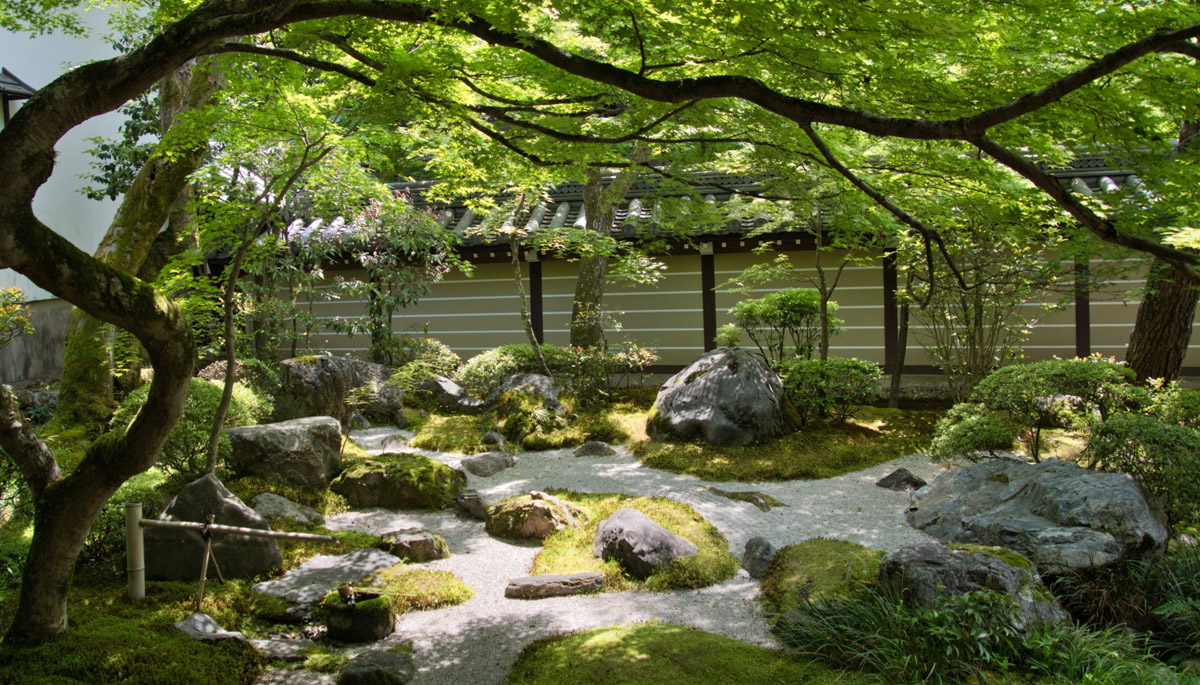
Japanese gardens arrange stones, water, plants, and empty space to create balance between nature and human design.
When thinking about wa in Japanese culture, the relationship with nature is essential. Since ancient times, people in Japan have found sacredness in mountains, rivers, forests, seas, rocks, and trees. Nature has often been understood not as an object to be controlled by humans, but as a presence connected with human life and deserving of respect.
Many shrines are located in places connected with nature, such as forests, mountains, springs, and seashores. Passing through a torii gate, walking along the approach, and entering a shrine precinct surrounded by trees becomes a time to step slightly away from daily life and face nature.
Japanese gardens also express the idea of harmony with nature. A garden is not nature itself, but it is created with stones, water, trees, moss, sand, bridges, and other elements in a way that condenses natural scenery. Large mountains and rivers may be represented within a small space.
What matters here is not leaving nature exactly as it is, but adding human care while making use of natural flow and seasonal change. The sense of creating balance between the artificial and the natural, without over-controlling or disturbing the space, leads to the aesthetic sensibility of wa.
The Aesthetics of Wa
The aesthetics of wa tends to value overall balance, empty space, and restrained beauty more than flashiness or strong assertion. Of course, Japanese culture also has splendid decoration and powerful expression. However, the beauty associated with the word wa often includes quietness and calm.
For example, a tea room is not a large space. Rather, it is small, simple, and restrained. Within that space, the tea bowl, flowers, hanging scroll, light, sound, fragrance, and human movement create a single moment. Each element does not stand out strongly on its own. Instead, they produce a quiet harmony as a whole.
In flower arrangement, it is not always the number of flowers that matters most. The direction of branches, the surrounding empty space, and the relationship with the vessel are also important. Empty space is treated as part of the work. This sense of space is also found in Japanese painting, architecture, gardens, and calligraphy.
The beauty of wa is closer to “choosing what is necessary and arranging the relationships among the elements” than to “decorating with many things.”
Wa and the Sense of the Seasons
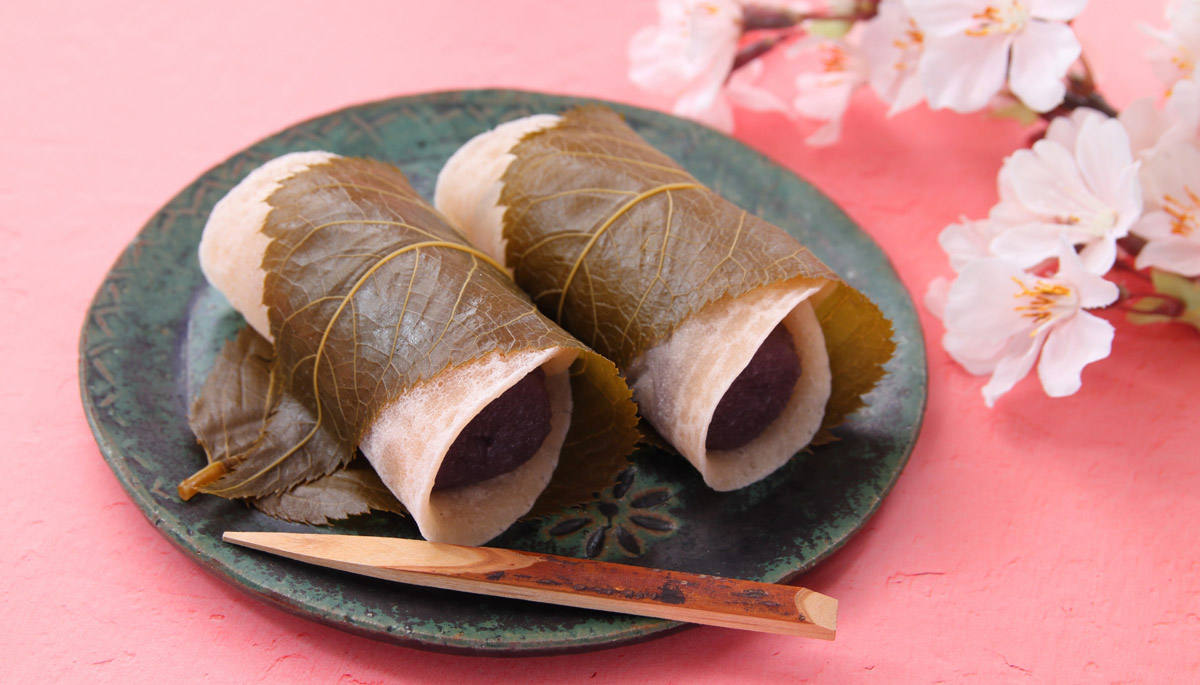
Seasonal motifs in food, tableware, and decoration show how Japanese culture brings nature into daily life.
Japanese culture has long valued bringing the changes of the seasons into daily life. Cherry blossoms in spring, coolness in summer, autumn leaves, and snowy landscapes in winter have all been reflected in waka poetry, haiku, painting, cuisine, kimono, and seasonal events.
In Japanese cuisine, seasonality is expressed not only through seasonal ingredients, but also through tableware and presentation. In spring, pale-colored dishes and mountain vegetables may appear. In summer, dishes and vessels that suggest coolness are chosen. Autumn may be expressed through colors reminiscent of maple leaves, while winter brings warmer foods and a sense of comfort.
Kimono patterns also use seasonal plants and natural motifs. Cherry blossoms, plum blossoms, chrysanthemums, autumn leaves, snow-ring designs, waves, and clouds are not merely decoration. They can also communicate the season and the meaning of the occasion.
Bringing a sense of the seasons into daily life means not simply looking at nature from a distance, but living in step with it. Here, too, the idea of wa appears.
Wa Is Not Mere Conformity
The word wa is sometimes associated with prioritizing the group over the individual, reading the atmosphere, or avoiding conflict. It is true that Japanese society has long valued acting with awareness of one’s relationships with others.
However, if wa is explained only as conformity or silence, its wider meaning becomes invisible. Wa does not mean erasing all differences. It is the idea of combining different thoughts, positions, roles, materials, sounds, colors, and seasons so that the whole relationship does not fall apart.
Just as music needs multiple notes to create harmony, wa requires difference. In a garden, stones, water, trees, moss, and sand each have different qualities, yet together they form one space. In human relationships as well, true harmony is not necessarily found when everyone holds the same opinion. It is closer to maintaining a relationship while understanding one another’s differences.
In this sense, wa is not about erasing the individual. It is easier to understand it as arranging the relationship between the individual and the whole.
Wa in Modern Society
The sensibility of wa remains in many forms in modern Japanese society. It can be seen in staying quiet on public transportation, waiting in line, being mindful of relationships at work or school, and sharing roles in local events.
The idea of wa also appears in modern design and architecture. Spaces that use wood, buildings that bring in natural light, designs that make use of empty space, and gardens or plantings that express the seasons can be understood as modern expressions of traditional wa.
Wa is not a word that belongs only to the past. Even in modern daily life, it can be understood as a way of reconsidering relationships: between people, between people and nature, and between objects and space.
At the same time, modern society also values diverse perspectives and individual will. When thinking about wa today, what matters is not simply adjusting oneself to others, but seeking ways to live together while respecting differences.
Conclusion
Wa is the Japanese idea of harmony. It appears in many forms: maintaining peaceful human relationships, connecting nature and daily life, considering the balance of spaces and tools, and bringing seasonal change into everyday living.
Wa is a word that expresses Japanese identity, but it is also a way of arranging relationships among different things. People and people, individuals and groups, nature and buildings, sound and silence, empty space and expression, tradition and modernity: within wa is the attitude of seeking a natural balance among these elements.
When trying to understand Japanese culture, it is too narrow to think of wa simply as “getting along” or “becoming the same.” If we see it instead as a sensibility that recognizes difference, arranges relationships, and seeks a calm condition as a whole, we can better understand the connections among Japanese etiquette, housing, food culture, gardens, arts, and social life.
To understand wa is to understand a quiet depth within Japanese culture. By paying attention to the sense of harmony found in buildings, food, language, seasonal events, and everyday behavior, Japanese culture begins to appear with greater depth and dimension.

Comments