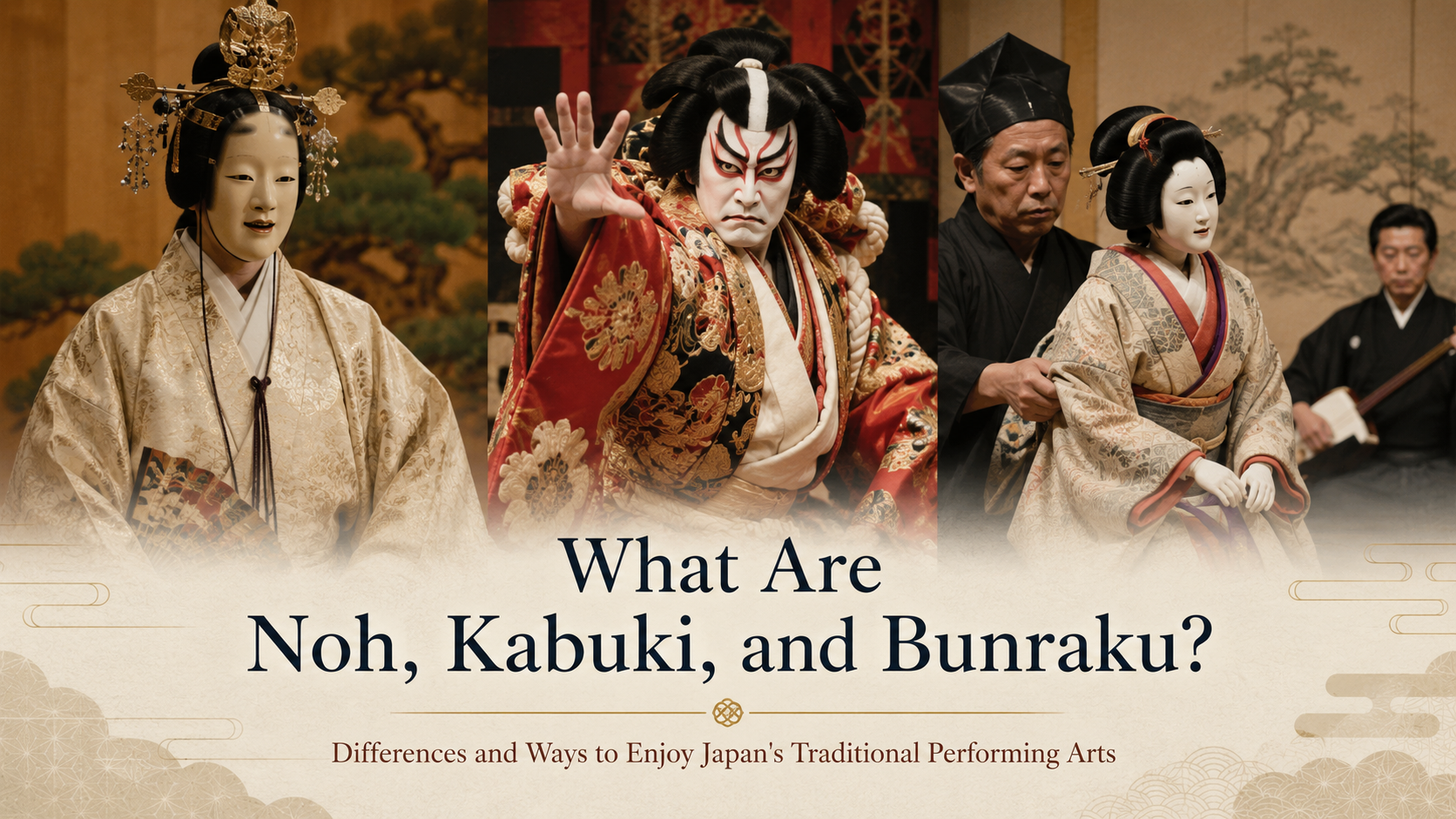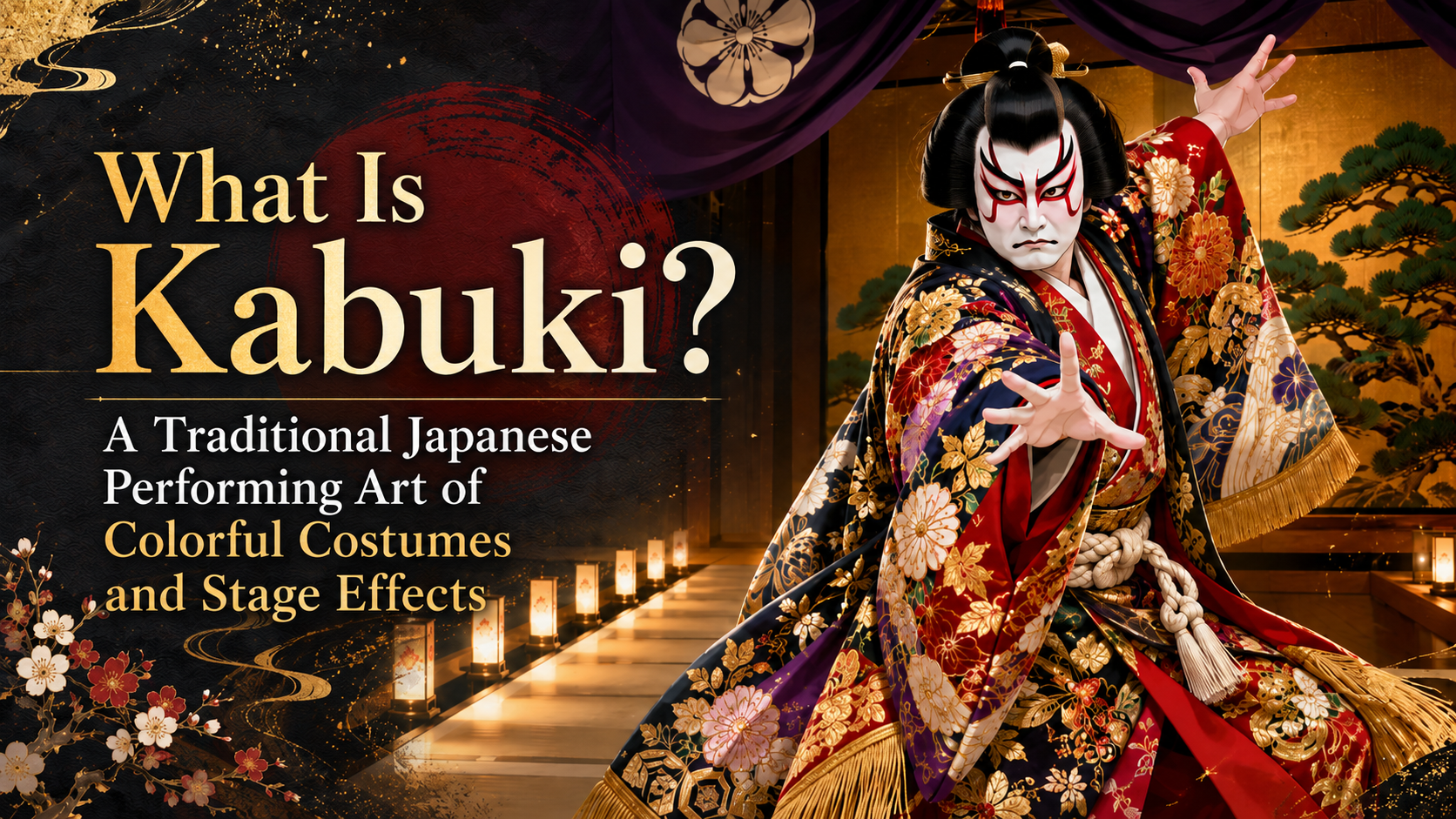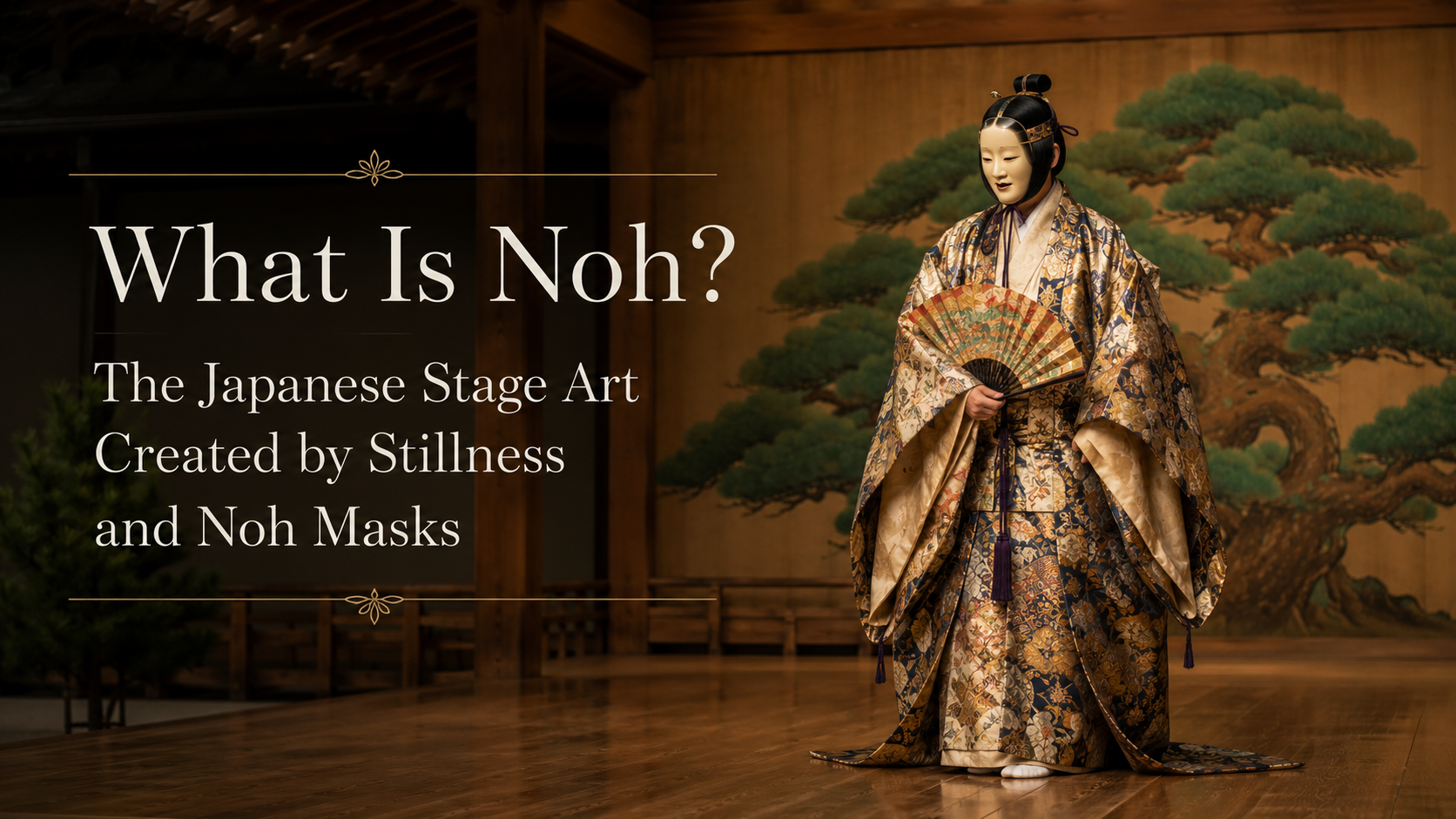
Noh is one of Japan’s representative traditional performing arts. In English, it is written as Noh or Noh theater. It is known as a stage art that expresses stories and emotions through Noh masks, chanting, stylized movement, and musical accompaniment. Unlike Kabuki, which is known for its colorful stage effects, or Bunraku, which expresses stories through puppets, Noh creates its own distinctive world through stillness, open space, and symbolic movement.
For people seeing Noh for the first time, it may feel a little difficult because the movements are few and the pace is slow. However, the appeal of Noh does not lie in easy-to-understand actions or dramatic scenes. It lies in subtle gestures, the resonance of the voice, the angle of a Noh mask, and the quietness of the stage. This article explains what kind of stage art Noh is, what meaning Noh masks and movements have, and what first-time viewers may want to notice.
What Is Noh?
A Traditional Performing Art Expressed Through Masks, Chanting, Movement, and Music
Noh is a traditional Japanese performing art made up of masked performance, chanting known as utai, stylized movement, and musical accompaniment called hayashi. On stage, the emotions of the characters and the development of the story are not explained only through direct dialogue or large movements. Instead, the world of the story gradually appears through slow steps, quiet bows, the handling of a fan, and the resonance of the voice.
Noh is not a stage art that clearly shows emotions through scene changes or facial expressions in the way modern theater or film often does. Rather, it leaves space for the audience to sense the meaning of what is happening on stage. For this reason, first-time viewers may feel that it is difficult to understand what is taking place. However, it may be easier to appreciate Noh if it is understood as a cultural experience that is felt through quiet concentration, including that sense of mystery.
A Sense of Time Outside Everyday Life
A Noh stage has a flow of time that feels different from ordinary life. The movements are slow, and the music has a distinctive sense of pause and rhythm. The audience does not follow a fast-moving story. Instead, they place themselves within a stage atmosphere that changes gradually.
Noh stories may include historical figures, gods, spirits, women, warriors, travelers, and other characters. Some works deal with the thoughts of the dead, attachment to past events, prayer, or repose of the soul. Rather than showing events in a realistic way, Noh often expresses the depth of human emotion and time through memory, dreams, and spiritual worlds. This is one of its distinctive qualities.
The Expression Created by Noh Masks
A Fixed Expression That Creates Many Emotions
One of the most symbolic elements of Noh is the Noh mask. At first glance, a Noh mask may seem to have a fixed expression. However, when the performer raises or lowers the angle of the face slightly, the impression of the mask changes. Depending on the way light falls on it and the direction of the performer’s body, the same mask may appear sad, quietly smiling, or deeply thoughtful.
A Noh mask is not simply a tool for hiding the face. Rather, it is an expressive device that draws out the imagination of the viewer through a limited range of expression. Because the expression does not change dramatically, the audience becomes more aware of small differences. This subtlety is one of the great appeals of Noh masks.
Masks Show the Role and World of the Character
There are many types of Noh masks, representing women, old people, warriors, gods, demons, spirits, and other beings. The choice of mask changes the nature of the character and the atmosphere of the stage. Some masks represent young women, some show women carrying deep sorrow, some represent elderly figures, and others express intense emotions or supernatural beings.
For English-speaking readers, Noh masks may be one of the most memorable elements of Japanese mask culture. However, they are not merely decorative objects. They come to life as stage characters only when combined with the performer’s body, voice, the stage light, and the gaze of the audience.
The Meaning of Quiet Movement and Dance
Giving Meaning to Small Movements
Noh movement is highly restrained. Walking, stopping, turning, and opening a fan are all performed slowly. If you are used to modern stage expression, the movement may seem limited. However, in Noh, because there are few movements, each gesture carries weight.
For example, even a single step forward may suggest a change in the scene or a movement in the character’s heart. The angle of a fan or a slight change in body direction may show the character’s emotion or situation. Noh movement is not movement for explanation. It is movement that condenses meaning.
Dance Expresses Emotion and Memory
The dance in Noh is not simply meant to be beautiful. Through dance, the emotions of the character, memories of the past, prayer, sorrow, attachment, and other inner states are expressed. In particular, in scenes danced in the latter half of a play, the inner world of the character may quietly come to the surface.
When watching Noh dance, it is helpful not to look for speed or visual excitement. Instead, notice the pauses, the changes in weight, and the reasons a performer stops or slowly turns. Thinking about these movements can deepen the impression of the stage.
The Sound World Created by Chanting and Hayashi
Chanting Supports the Story and Emotion
In Noh, chanting is also an important element. Utai does not only convey the lines of the characters or explain the story. It also creates the atmosphere of the entire stage. Through its distinctive melodic style and vocal resonance, the world of the story expands.
Even if you do not understand every word, you can sense the tension of a scene or the depth of emotion through the strength, pitch, and pauses of the voice. For English-speaking viewers, fully understanding the language of Noh may be difficult. Even so, listening to the voice as sound can make it easier to enter the world of Noh.
The Flute and Drums Change the Atmosphere of the Stage
The musical accompaniment in Noh, called hayashi, includes instruments such as the flute, small hand drum, large hand drum, and taiko drum. These sounds are not simply background music. They are essential elements that support changes in the scene, the emotions of the characters, and the tension of the stage.
The sharp sound of the flute creates an otherworldly atmosphere. The sounds of the drums create pauses and give strength to the movement. In Noh, sound does not continue constantly. Both the moments when sound is heard and the moments when it is absent have meaning. This sense of pause is also an important point in appreciating Noh.
Features of the Noh Stage
A Simple Stage That Draws Out the Imagination
The Noh stage has a very simple structure. There are almost no large stage sets or detailed backgrounds. On the back panel, known as the kagami-ita, a pine tree is often painted, and the stage itself has a wide sense of open space.
This simplicity activates the imagination of the audience. Even when mountains, seas, mansions, or battlefields are not physically built on stage, they emerge through the chanting, movement, and sound. Noh does not show everything in visible form. Its appeal lies in suggesting a large world through a small number of elements.
The Hashigakari and Its Unique Space
A Noh stage includes a passageway called the hashigakari. Performers enter the main stage through this passage. The hashigakari is not just a walkway. It has a role that seems to connect the real world with the world on stage.
When a character slowly advances along the hashigakari, a unique tension is created. The audience watches while sensing what kind of being the character is and from what kind of world they have come. The space of the Noh stage itself becomes an important element supporting the story.
Points to Notice When Watching Noh for the First Time
Read the Summary in Advance
If you are watching Noh for the first time, it is helpful to read a summary of the play beforehand. The language of Noh is classical, so it can be difficult for first-time viewers to follow the content on the spot. Knowing the general flow of the story and the relationships between the characters makes it easier to understand the movements and chanting on stage.
However, you do not need to memorize the summary. It is enough to know who appears, what background events are involved, and what kind of emotion appears at the end.
Pay Attention to Masks, Movement, and Sound
When watching Noh, it is helpful to focus on three elements: masks, movement, and sound. The impression of a mask changes depending on the angle and light. The movement may seem minimal, but walking and stopping have meaning. The sound of chanting and hayashi creates the atmosphere of the stage.
Even if you do not understand all the words, you can still feel the world of Noh by observing these elements. In particular, when you notice how one movement or one sound resonates within the quiet stage, the distinctive tension of Noh becomes easier to sense.
Do Not Try to Understand Everything at Once
Noh is not an art form that can be fully understood the first time you see it. For that reason, it may be better not to try to understand everything perfectly from the beginning. Instead of focusing too much on the details of the story, begin by taking in the quietness of the stage, the impression of the mask, the resonance of the voice, and the lingering feeling of the movement.
The appeal of Noh may come back to you gradually after the performance. Some scenes that were difficult to understand while watching may remain in your memory later. This lingering impression is also one of the ways to enjoy Noh.
Why It Is Worth Seeing Noh in Japan
Feeling the Atmosphere of the Stage in Person
Noh can be watched on video, but the impression changes when you see it on an actual stage. The texture of the wooden stage, the sound of the performer’s footsteps, the resonance of the instruments, and the quietness of the audience are all elements that are difficult to feel unless you are there in person.
Especially in Noh, moments without sound and scenes with little movement also have meaning. By experiencing these quiet pauses in the same space as the performers, the tension and depth of Noh become easier to feel. The value of seeing Noh in Japan lies not only in the performance itself, but also in experiencing the atmosphere of the whole theater.
Encountering the Quiet Aesthetic Sense of Japanese Culture
Noh expresses a quiet aesthetic sense often found in Japanese culture. Valuing open space, avoiding excessive explanation, placing meaning in small movements, and blurring the boundary between reality and dream are all sensibilities that can also be found in other forms of Japanese culture.
Like tea ceremony, ikebana, and gardens, Noh is a culture that finds deep expression within stillness. Watching Noh is not only a way to learn about Japanese stage art. It is also an opportunity to encounter a way of seeing and feeling that runs through Japanese culture.
Conclusion
Noh is a Japanese stage art created by stillness and Noh masks. It does not tell a story through large movements or flashy effects. Instead, it expresses emotion, memory, and a world beyond everyday life through masks, chanting, dance, musical accompaniment, and the open space of the stage. Its expression is restrained, but the stage contains a unique tension and lingering beauty.
When watching Noh for the first time, you do not need to understand everything. Reading a brief summary beforehand and paying attention to the mask, the slow movements, and the resonance of chanting and music can already help you sense its appeal. For travelers who want to encounter a quiet form of traditional performing art in Japan, Noh can become a deeply memorable cultural experience.